N.B.Coop News

Breaking, broken…Good, bad…Old, new…Global, national, local…Facts, figures, fantasies…Letters, notes, opinions…All the news fit / unfit to post, print, scatter… Norbert Blei – publisher & editor | Monsieur K. – managing editor

Page 4 of 7

march notebook

MARCH Notebook

THE EVIDENCE ALL AROUND STILL SPEAKS WINTER…the snow has not yielded the fields; the ice has not revealed the rivers, the creeks, the lakes, the low wetlands; temperatures at night remain comfortably below freezing; the furtive wind seeks its familiar northern pathway; there is a silence everywhere about to speak.

THE FIRST SPRING CALL OF THE CHICKADEE…such a plaintive cry, finally heard this early March morning after cold and snowy weeks of waiting for something that speaks spring to arrive. It’s even more reassuring, more bitter sweet, earlier in the year…back in February, in January, in those days when winter is tangled in an old man’s workshed-mind as he rummages through seasons of junk and discontent and suddenly discovers an old red fishing bobber warming his hand.

MORNINGS WHICH COULD BE OCTOBER…unraveling in a slow dance of fog, heavy and cold breathing, the solitary walker’s footsteps borne aloft amidst black, wet trunks of trees waltzing by, fields and farmhouses drifting forward and back in a rhythm of waves, the caws of crows wrapped in gauze, the world waiting invisibly for revelations of sun.

THIS IS THE TIME OF THE THIN ICE…the saturated snow, sap running from the maple trees, chipmunks and squirrels scampering across the sometimes wet, sometimes frozen earth, birds finding their way back, mornings and evening dressed in fog, the sun trying to distinguish itself in a black and white photograph. A knock at the back door: no one is there.

TALK WITH A NEIGHBOR YESTERDAY…who keeps eyes and ears attuned to the natural setting. “Red-winged black birds are back. I could hear their call in the trees the last few days,” he says. “Crows nesting. Meadowlarks should be here soon. Peepers in another month, still too much ice for them to come out.”

SLUSH…the seasons still teasing each other on the first day of spring, 32 degrees, rain falling all night, snow falling all morning. Slush. Walks, pathways, roads, fields covered in white, filled with this magical mixture, water and white. Along the trunks, high into the lacy branches of beech, birch, maple and pine, winter has etched its beauty along the dark lines…birds shake their feathers, horses shake their heads…smoke from the farmhouse chimney climbs then merges gray into white. Winter exercising its failing strength. Only a momentary thing now. The miracle of air, of water, of snow. Snow no longer what it was. Snow what it is: a magic act. Invisibly visible. At the mercy of warmth. The coming sun, only moments away. The advance of spring. Now you see it, now you don’t.

MARCH 21…Robin.

MARCH 23…Robins, robins, robins…

THE SEE-SAW BATTLE WAGES ON…mornings of thick, wet snow followed by afternoons of warmth, of sun, of the white lifted off the landscape like the quick vanishing act of a magician’s hand, like a woman removing a bed sheet with a flap of two arms…revealing the dull earth in all its tangled confusion–leaves, sticks, stones, earth–of late last fall. Lasting for days. Followed by thick, wet snow blanketing the earth again.

THIS IS THE MOMENT BEFORE RESURRECTION…when the earth’s bare bones protrude through the dead grasses and blanched leaves…broken and dead branches, stones, birch bark, the ground littered with the broken limbs of trees. Color, if it can be called color at all, muted browns, qualities of gray, shades of yellow in stages of decomposition a long, long time. A quiet medley in morning, decay, where even the suggestion of funereal black seems too rich for this soundless, sameness theme of dereliction. A certain weightiness of angst that has suffocated the earth for weeks, now that the snow has gone, leaving it lifeless, the color of old tallow, with hardly a memory of green.

THE BAY THIS YEAR (Sister Bay) STILL LOCKED IN ICE… (Consult `The Ice- Out Chart’ compiled by Bill Bastian.) Some it won’t move till two winds blow simultaneously–one out of the northeast, the other out of the southwest. Others say it should happen soon because the ice in the bay has turned black. Only a short distance beyond the ice, however, open steely-blue water as far as the eye can see.

THIS IS MARCH MAGIC…the sight of men deep in snow, deep in their orchards on a mild winter day, pruning apple and cherry trees; cold nights, mild days–the sap is running, the trees are tapped…maple syrup time; wind howling its warm and cold memories of the at its mercy of sound and invisible strength; the snow-cover along the road’s edge, slowly drawn back like a blanket by the sun each day, exposing more and more earth; the first sound of a robin, March–the first day of spring, March—the first regret that the privacy of winter will soon be lost.

IT ALWAYS RETURNS WHEN YOU LEAST EXPECT IT…winter snow, which both breaks and lifts your heart. Your mind is in two places: that need to recapture the returning song of the unseen robin in the woods just a day or two ago. The yearning to extend the white curtain of isolation a little longer. You are better in winter. A better human being. More tolerable. More thoughtful of the darkness within you. More holy. More serene. The silence suggests the comfort of a quiet end. You have been taken away. Disappeared..

UNDER A CAT FUR SKY THIS LAST MORNING OF MARCH…amidst a final gasp of new fallen snow last night, filigree-ing the branches of old maples and birch, threading the high electric wires stretched down the road to infinity, dusting the fields and fir trees …the sudden stop-and-go burst of robins everywhere, flashes of sunny breasts helter-skelter through the woods, to the tops of trees and telephone wires, and down to the fields, a sweep of charcoal gray wings into a stand of pines, fluttering snow.

TO LOOK UP FROM THE DESK AND OUT THE WINDOW AT 5 P.M…and still see daylight at this time of March, both delights and saddens me. I need that late afternoon, lingering sun…that drowsy vermillion light that warms the bark of the white birch to a rosy glow. I think of the days ahead and that same light stretching into 7, 8, close to 9 o’clock at night when I will know again the pleasure of coming back to the coop and working on into darkness. That same darkness that I miss now…that disappears a little earlier each day with the change of season. I want the early darkness. I want winter and night outside my window at 4 P.M.

SIGNS OF THE LAMB….the narrow path through the snow I have shoveled all winter, from inches to snow to a late March depth of more than two feet. But with the thawing of the past few days, I watch the path visibly spread, grow wider with each day…now last fall’s leaves, dead grasses, the wet muddy earth at my feet; the chipmunks have awakened…tame, gentle, amazed at the sight of snow they carefully tread. Comic creatures caught above the earth on a landscape they find impossible to negotiate, running crazily here and there, back and forth…put of place, out of time…squirrels, too, encouraged by their time-clocks are now chasing partners across the snow covered ground, up and down tree trunks (occasionally fully engaged), acrobatic acts from tree to tree along the mazed circuitry of bending branches, sometimes, incredibly, missing the connection–as yesterday, when suddenly a squirrel came plummeting at fifty feet from the sky, head first past my window, landing in a one foot cushion of snow, shaking it off and dashing up again. But, ah, the serenest sight of all–here and there in some of the woods that still sing the old songs of March: galvanized buckets hanging lazily from thick trunks of old maple trees, gathering sap all day, a drop, a drop, a drop at a time.

REMEMBER, Remember, remember…The furnace still going on at night…the continued comfort of sweaters and flannel shirts….Cold , cold rain….– norbert blei

promises made/broken & other matters

Promises Made/Broken & Other Matters

February 3, 2011

Goodbye for awhile: February 5th to the 13th. Hate to leave my rural winter wonderland behind me, but “recuperation calls”–travel to warmer climes. Headed west to sunny San Diego to see my son, daughter-in-law, and granddog, Sophie, queen of the Giant Black Schnauzers.

UNFINISHED BUSINESS

(Notes on the Desk to Myself and Others):

Promises Made: If I fulfilled whatever I promised last year, this year so far, consider yourself lucky–and me pleased to know I accomplished something!

Promises Broken: I lost track of too many things last year during the cancer bout, hospitalization, operation, and forever ongoing recovery. If I never answered your e-mail and it was URGENT that I respond, my apologies. Get back to me—if it was urgent. E-mails that I mentally put on ‘hold’, that I assure myself I will answer when time permits, have a tendency to get buried as the next daily batch come in, many of which are also put on hold You all know where that leads.

More Broken Promises: to writers and others I intended to work with on one project or another. If I promised to do something on you, your work, conduct an interview, review your book or someone else’s you recommended, etc. and STILL have not gotten around to it, please remind me, though a number of you still hover in my head, while others may be lost or out of focus. I’ll do my best to make it happen as time permits.

Part of this (to beat the same old drum) the nature of my health condition as I continue plodding the recovery path…a step forward, a long trek back, a look sideways, baby-steps forward again, a late morning or afternoon pause in my living room chair, awake/asleep/drifting into sonorous headphone-earfuls of Bach–sound escape, followed by a sudden, discomfort of food grazing with no appetite…cover me in blankets of gray, angry, uncomfortable, unhappy a moment, an hour or two seeking again the lost old self outside the snowy black window. now, much later, in the hour of our darkness amen … seeking recovery in time’s pages…inhabiting Joyce’s rhythms and images …snow falling on tombstones… “…snow… falling on every part of the dark plain, on the treeless hills, …falling upon every part of the lonely churchyard…It lay thickly drifted on the crooked crosses and headstones…His soul swooned slowly as he heard the snow falling faintly through the universe and faintly falling like the descent of their last end, upon all the living and the dead.” Then a new next morning pause upon the road to watch the sun rise…followed by another long or short visit of an oncoming cloud cover (how will THIS day go?)… grabbing a Zennish here-and-now moment for what it is…a sunny morning sanctuary of resurgent faith in nature to just keep on being and being, no matter the mid-morning poor focus that waits in the wings clouding the flight of unconsciousness.

The other part of this, prosaically, goes almost without saying: Too much to do. Too many distractions. Too many deserving subjects. Too much stimulation. Curiosity unlimited. I move from one promise, passion, idea to another…to suddenly find myself preoccupied, obsessed with something else that deserves attention.. The other idea (just as deserving) begins to fade ONLY because the new one has completely taken hold. I can’t get it out of my head. If I pause—I may lose it. If I follow through—a gift to myself, to others. Maybe. But worth it, whatever. Maybe karma. Maybe plain old confusion. Can’t help it, myself–not always a bad thing.

My Websites:

www.poetrydispatch.wordpress.com
www.bashosroad.outlawpoetry.com
www.nbcoop.outlawpoetry.com
www.onceuponatime.outlawpoetry.com

As of over a month ago, add to the sites listed above: www.onceuponatime.outlawpoetry.com

This is the new site I had hoped to devote to the art of the story. The short story. Anything and everything dealing with ‘story.’

For the most part I have been pleased with the initial offerings for ONCE UPON A TIME and the responses from readers, though I seem to have run into some trouble with the last posting (above, ‘the-brothers-grimm”) as it did not get to everyone. Most of them “FAILURE TO DELIVER” I’m still not sure what happened and ask you to please try again.

My main point in this posting: the importance of fairy and folk tales in the history and development of the short story. What’s more, the great contribution of the Brothers Grimm. A favorite Grimm story of mine is reprinted for this blog. A little long…perhaps a little too long. But that seems to be the nature of the beast—this new blog devoted to story. Though we call the art “the short story”, many stories are not that short. A good story takes patience and concentration to pursue. Followed by reflection. (What was that story all about?)

I have tried (will continue to try) to select stories that are reasonable in length, knowing full well that internet readers prefer “the-shorter-the-better”. Short in the way Poetry Dispatch and Basho’s Road usually run very short.

If I can’t make ONCE UPON A TIME work to everyone’s liking and learning…I will probably let the site go as yet another failure of a grand experiment.

In the meantime…let’s try to make it work.

I’m aware too that some readers (older especially) have trouble reading white on black. Most computer programs have provisions for changing the text…making it larger…reversing the background to black words on white, etc. Please look into this if you are having problems.

In the meantime…I ask you to revisit the above, most recent link to ONCE UPON A TIME (the brothers grimm). I I’ll also try to get something new up before I leave. But if not…and while I’m gone…please spend some time revisiting the archives of any and all of the other websites. There is so much great material there. All of it worth many more reads…and passing on to friends.

There’s more, but that’s all for now.

Thank you for your patience…for being there…for your continued interest in my work, these websites. Stay tuned for coming attractions.

norb blei

alice d’alessio | a place to be safe

The Washington Island /CR+Press Writing Workshop/Contest Awards

by
Norbert Blei

I’ve just come back from my daily trip to town—the Post Office, the Pioneer Store, etc. and my usual, meandering return home down favorite back roads on the tip of the peninsula.

Inevitably my car finds its way down the curving road toward the dock at Northport to see if a ferry’s in, coming in or just left for the Island. I can’t explain the attraction. Maybe just the idea I can travel still further, be in another place, an island existence, less than five minutes from my house. Maybe just the beauty of the setting, so compelling in all seasons, whatever the weather. Open water … snow and ice at this time of year. I seem to be the unofficial Island watchman, intrigued with ‘elsewhere.’

Maybe I’ll walk out on the dock to inspect the scene more closely. Maybe I’d like to board the ferry myself on a winter day like this and just drive around the snowy landscape all day till I’ve had my fill of snow and silence and isolation. Maybe Captain Dick Purinton will be in the wheelhouse and I’ll visit with him. Maybe I’ll meet some tourist, wondering what’s over there. Or maybe nothing’s doing, like today, and I’ll just look out over the frozen landscape, listen to the wind, feel its sharpness on my face. Maybe take the camera out of my coat pocket and add yet another photo to the hundreds I’ve taken from this perspective.

Heading back home minutes later, I’m savoring the ferry dock moment of that beautiful separation between land and water…how lucky I am to be living here. How to be in the midst of all this wonder lifts my spirit considerably. How I continue to think: I could easily become an Islander. Though I’m happy to be headed back to the coop with my mail…happy to continue where I left off with the writing. Happy to be going into the house a little early this afternoon to bake some bread, take in all the ‘ovenly’ aroma in the kitchen, listen to the Metropolitan Opera on public radio…gradually ease myself into the comfort of the living room, a favorite chair, peruse one of the many books I am reading—all the while keeping an eye on the silence and beauty of winter outside my window …thinking ‘island,’ separation, snow…drifting off myself momentarily. The “ah” of being.

I’ve thought about teaching a writing workshop in winter on the Island for many years but never seem to get around to it. Last fall, however, September 24-26, 2010 (still in my recuperation mode), I gathered what energy I could and met on the Island with some of my Clearing writers for an autumn workshop. Everything came together perfectly in place.

I took little to no part in organizing the event, given my health condition. I preferred to keep the class small, no more than a dozen people. No public announcement or promotion. Dick Purinton, provided not only his knowledge and love of the Island to the class members, but the space (his late father-in-law, Arni Richter’s house) where we met at three long tables in a comfortable living room with a stunning view of Lake Michigan . Karen Yancey (summertime Islander and writer) contributed much in spearheading the workshop, keeping people informed, handling lodging, creature comforts, etc. along with Jude Genereaux who provided her organizing expertise.

I spent a few weeks preparing for the workshop, finally settling on the idea of “island” as metaphor…perusing many books and authors, gathering work, copying materials that would serve as the groundwork to an island writing experience. I was satisfied with the course I came up with (to be taught all day Saturday), hoping I would have the energy to sustain my drive morning and afternoon, fearful my voice would not hold up. But all went well, though there were evenings and Sunday morning I was unable to attend.

In my final words to the class late Saturday afternoon, I surprised myself by announcing a writing contest. Something they might work on once they left the Island. An Island ‘story’ to be sent to me by Thanksgiving, even though we did not study the art of short story writing. There would be a First Place monetary award. A Second Place “lunch in the county” on me. And a Third Place award of either a book from my personal library, which I continue to downsize yet still passionately purchase new ones, or a watercolor of mine, also in the downsizing mode of my archives. The contest was optional. Just a little ‘homework’.

I told them to reflect upon what we had read, discussed, written, and learned about the setting from one specific Islander (based on a class interview I had arranged with Dick Purinton) …plus all that they might still discover about the people and place on their own. I wanted them to create fiction…a good story, reflecting some sense of island existence.

About half the class followed through. I had hoped for a few more. Then again I’m more than aware these days how impossible it is for me to meet deadlines and schedules. Most of their lives are a lot busier and more complicated than mine.

I took take myself out of judging the stories and scattered the critiquing among four other writers and/or good readers, in and out-of-state. I removed the names of the authors from their work. I read the stories myself for the first time only a few nights ago—without names as well.

I found myself mostly in agreement with the judges, though I might quibble a little here and there. The hardest choice seemed to be Third Place, which was a tie amongst the judges in more ways than one.

It was my decision to create a Third Place, High Honorable Mention category because all the work seemed deserving of such mention, as I carefully read each story more than three times, and in light of the fact the judges themselves considered multiple Third Place winners. A book or a watercolor for each writer.

Only the First Place story is featured online.

  • FIRST PLACE: “A Place to be Safe” by Alice D’Alessio

  • SECOND PLACE: ‘Island Life in Three Movements” by Maja Jurisic

  • THIRD PLACE, High Honorable Mention: “Infinite Possibilities” by Catherine Hovis, “Not Just The Usual Trip Home” by Jackie Langetieg, “Baker” by Ralph Murre, “Crossing Porte Des Mortes: A Tale of the Future” by Kris Thacher

A Place To Be Safe

by
Alice D’Alessio

The truth is, I was looking for someplace to hide. I didn’t tell Roz , when she invited me up to their place for the weekend, but she might have wondered why I blurted out YES almost before she’d finished the invite. To an island even. I’ve always had a fascination with islands, with water, with rocky outposts and crashing waves. But now, I needed to get away from the man who was ruining my life. I needed a safe place to think. I was trying to make sense out of the jagged sequence of the past few weeks.

So I felt an excitement, a sense of escape, as I climbed on the ferry to Washington Island where I’d never been before. I had stashed my home computer with a friend and turned off my cell. There wouldn’t be any way for him to trace me. Jake, who had been charming once, and now was not. He’d been lying to keep me from knowing he’d lost his job; he was stealing from me, drinking again, and god knows what else.. When I had told him to leave it was ugly. Threats, Police. All those things that make up TV drama and end up being crime scenes. Scenes you never expect to find yourself in.

“Nothing fancy,” Roz assured me. ” The season’s over and most of the tourists are gone.
We’ll be closing up the cabin soon ourselves.” I didn’t tell her how I was grasping at this trip like a drowning swimmer grabs for the life preserver. I’d checked out Washington Island on Google. The only way to get there was by ferry. Perfect! It was only about 6 miles long and about the same wide. And some 600 people lived there, full time. Did that mean 100 people every square mile? My math wasn’t good enough to figure that out; Jake could, but Jake was history.

The weather was wild, the wind frothing the waves, but it didn’t deter the ferry. Most of the passengers – maybe two dozen – were inside in a glassed-in cabin. I found a seat outside on the back deck, where I could be alone and watch the way the tattered clouds kept chasing each other across the sun. When I left Milwaukee that morning it was a lot warmer and I was wishing now I’d put on socks and maybe a sweater under my windbreaker.

We’d barely left the dock when a woman plopped down onto the seat next to me. She was zipped up to the neck in a turquoise quilted raincoat with a stocking cap pulled down to her eyebrows. I scrunched over so as not to be touching.

“Your first ride over?” she asked, nodding at my shorts and sandals and probably the goose bumps on my thighs.

“Ummm – yeah. I didn’t think about it being this cold…”

“Sorry we couldn’ta had some better weather for you,” she said cordially.

“Oh – I don’t mind it. Is it usually pretty rough?”

“Oh yah, you betcha. This ain’t nothin,’ really.” she said. ” It’ll settle down some when we get acrost this stretch and past Plum Island.” She pointed to a narrow island, like a long furry animal in the water ahead. “Our Cap’n now – we’ve got the head guy today, Eric Swenson – he knows this water back and for’rd. He’s a former Navy man , you know. Been runnin’ this ferry line for probably 30 years now.”

“Really?” I said, seeing that she wanted to talk. This was good because I realized I didn’t want to think. Anything she wanted to tell me about Washington Island or ferries was a lot better than what was jangling in my head like a bad soap opera. Not that the tape didn’t keep playing in the back of my brain, but it was muted.

She was moving right along – Mae, she said her name was, Mae Berenson. “Yep – he married old Olaf’s daughter . Olaf, he started the line. Died last winter. They say he didn’t want to give up, right to the end. That’s his name painted on the boat – the Olaf Nehlson. “

“Guess there’s lots of Norskis up here,” I laughed, and then wondered for a long moment if that was maybe an insulting term.

“Well yah – but mostly Icelanders. Some Norskis and Finns. Swedes too. We’re all Islanders now though. Don’t seem to matter what old country the ancestors come from.”

“So this Mr. Swenson, he owns these ferries and runs them back and forth? All winter too?” I had to speak directly at her, above the roar of the wind.

“Pretty much all year, now they’ve got the ice-breakers on front. Used to be when it froze over, you was just stuck till spring. Or you could skate or sled or drive acrost. They still close down when the ice gets 10 inches thick, and it’s snowing real hard and the winds blowin’.”

I felt a shiver of excitement. My kind of place. The waves had grown progressively higher, the water a deep slate, tinged with purple or green, depending on the shifting clouds. From time to time a particularly strong gust would blow spray as high as where we sat. The boat rolled and veered to stay crosswise of the swells.

“So what draws people up here?” I asked. “What does everybody do when the tourists go home?”

“Oh, that’s when we really have fun. You know, then there’s time for church socials and potlucks, there’s the holidays, and some folks go away, but mostly their family comes. I don’t know. There’s a quiet and peace and you kinda breathe a sigh. Maybe you have to be born here to understand…Or else, some are just drawn, and they find a way to enjoy it. Eric Swenson, now, he come up to marry Roseann. Her folks was against it. They sent her off to school in California to meet fancy folks, and didn’t she meet a Navy man from Wisconsin!

Well, Mr. Swenson, he’s just fitted right in; leads the parades, joined the Legion and the Stavkirche; volunteers for everything.” She said his name with a kind of reverence.

We had rounded the tip of Plum Island by now, and sure enough the waves were calmer.
Mae settled her shopping bags at her feet, and pulled the stocking cap back to reveal a welter of gray curls. As if on cue, a tall, burly white-haired man in captain’s hat came from the upper deck and stopped beside her.

“Hey there, Mae. Thought I’d find you on this run. Have a good trip?”

“Hey Cap’n Swenson. Who’s piloting this tub anyhow?”

“Oh I let Gunderson take the wheel. It’s easy from here.”

“This here’s Maggie Russell,” she said, nodding at me, “it’s her first trip to the island. She wants to know what we do in winter.”

They both laughed. Turned out that’s the most common question they get. I was embarrassed to be so predictable.

“She’s stayin’ with a friend – the Youngmans – bought that farmhouse on State Line, close to the Art and Nature Center.”

He processed that information for a moment, and then gave me a broad, blue-eyes-twinkling smile. “Oh, you’ll be spending the evening at the Fiddler’s Roost,” he said. “Tony Youngman likes to play with the band there. I think they’re still open. Enjoy your stay.” He grabbed my hand in an enormous paw, and gave it a warm squeeze.

I was hoping to ask him some more questions, to show that I wasn’t only a run-of-the mill tourist, but he went on into the interior cabin and was greeted by the handful of passengers and possibly a tourist or two.

“How many people live on the island, full time?” I asked Mae.

“Well now, if Betsy Olson had her baby that’ll be 661,” she said., promptly. “They hafta go to the mainland now for havin’ babies. Used to be a midwife here would handle it, but I guess they didn’t think that was good enough. We got our own doctor last year, but he’s just here a couple days a week in winter, or more if there’s a call. Lives down Sister Bay area. Yep – Doc Yanicek – all the way from Chicago. He had a little trouble gettin’ adjusted. But then he takes lots of time off, too.” Mae looked like she didn’t approve of that.

“He wrote a book, you know, Cap’n Swenson.” she nodded toward the inside cabin.

“The captain?” I asked, surprised.

“Yep – some publisher down the mainland got hold of him and had him keep a diary for a year, and didn’t it turn out to be a best seller! “

I knew I’d have to get hold of a copy. Probably Roz would have one, or there would be some on sale at one of the shops. It felt good to be curious about something, after so many weeks of surviving bad stuff.

The wind was just as strong as ever, which made pulling alongside the dock a challenge. Waves swashed against the pilings, but the ferry sidled in as neat as if it were a calm day. Probably Captain Swenson had taken over. I said goodbye to Mae as we descended the metal stairs to the ramp. A clutch of people in coats and scarves waited on the dock. I could make out Roz in her long purple coat, and felt a bit silly to be wobbling down the steps in sandals and windbreaker .

“Well – look at you!” She hugged me. “Did you think this was Miami?”

She found a warm sweater in her trunk, and we made a quick tour of the island before dark. There seemed to be only about five roads, stretching beside farm fields, some with cows, some with wheat. A few stores, banks, gift shops and coffee houses were dotted along Main Road. Along the east and west sides of the island driveways led into wooded areas and waterfront vacation homes. Roz was talking a mile a minute so I hardly had time to put in my questions in, and then we pulled in by a white-painted farmhouse set back in some trees. “Here’s the digs,” she said, with more than a little self-conscious pride.

I sat at a counter with an Island Wheat – a beer made from local wheat, she told me – while she heated up a big pot of chili and made cornbread. Their “farmhouse” was a rustic place, obviously re-done, but not too designer-perfect or cutsie. Roz had repainted and put in her usual eclectic pots and baskets and art from friends at the fairs where she showed her watercolors..

We dragged Tony out of his study – where he does something on a computer – and dug into the chili and cornbread, all the while talking and asking questions and I realized how good it is to have friends, old friends, that do interesting things and don’t require lots of explanations. I didn’t want to say too much about Jake. They’d never met him anyhow, just knew I was living with someone – a new guy, I said; someone I’d met in the long gray aftermath of losing my husband Evan in Iraq. Evan had been Tony’s friend, which was how we’d all gotten together in the first place, back in Chicago. I’d lost touch with them for awhile; lost touch with everything. Moved to Milwaukee.

So I told them it hadn’t worked out with Jake, and then told them about Mae Berenson, and of course they knew her, and I wondered what it would be like to live in a place where everybody knew everybody else, their quirks and health and whereabouts.

“Of course, it’s different for us,” Roz pointed out. “We’re not Islanders – just summer people, but since we’ve been coming for over 15 years, we’re almost accepted.”

“They’re only a little suspicious, ” Tony explained, “we’re maybe not the real authentic item – but not aliens either.”

“How long do you have to live here before you’re an Islander?” I asked.

“Oh you can’t ‘become’ one, you have to be born here. Even Swenson isn’t an Islander, and he’s been running that ferry line for 30 years, I’ll bet!”

“He told me you’d joined a band here, Tony.”

“Oh yeah – I riff with them a little. Are you game to go over to the Fiddler tonight? There’ll be some folks there. It’s probably the last week they’re open.”

I settled my stuff in an upstairs room under a gable, There was a single bed, and lots of kid gear and posters. “Randy’s room,” Roz apologized. They had a couple of teenagers who’d stayed home in Chicago with their grandma. Just out of curiosity I checked my cell and immediately wished I hadn’t. There were seven or eight text messages from Jake, with varying degrees of hostility, from “Hey what the hell? We got to talk. miss you, ” all the way to “Where R U bitch? U know U can’t hide from me!” Also one message from Margo, the friend with my computer, who said he’d stopped by her place to find out where I was. She told him she had no idea, but her message sounded uneasy. She was locking her door and turning off the lights, she said. My stomach took an unhappy lurch.

It was a short walk to the sprawling wooden roadhouse called Fiddler’s Roost. Unpretentious, neon beer sign in the window, long deck in front, long dark wood bar inside, deer heads on the walls. A handful of people turned from their seats and waved, and the two waitresses came over to greet us. At least you’d never feel like a stranger, I thought. But would it get suffocating? Right now, lonely and kind-of adrift in my life, it seemed warm and reassuring.

Tony put his guitar on the “stage” – a corner with a mike, next to the bar. “Are the guys coming over?” he asked the blond girl – Missy, they called her. She pointed over at the door, where a straggling of people were just arriving, including several with instruments.

The music was good; bass, fiddle, and a couple guitars, playing something between folk and blues, and having a wonderful time. After a couple gulps of beer I felt better. Meanwhile friends of Roz had joined us, including one introduced as Roy Yanicek, who turned out to be the island doctor. He was a short, sandy-haired guy who didn’t look old enough to have finished Med school yet. He pulled up a chair next to mine.

“Milwaukee girl? First time here?” He had a short, choppy way of talking, and never really met your eyes. Which is unnerving, and not a habit you want in your doctor.

I told him I was visiting, the Youngmans, and he nodded. “Out of curiosity,” I said, “how did you get here, and how’s it working out? Being the only doctor and all.”

He sighed and took a long draft on his beer. “Well, it’s not quite what I expected,” he said, looking around warily. He seemed not to want to elaborate, and after all, these were all his patients , so what could he say? Even though I was curious, I backed off.

“I was just trying to figure out what would draw people to live on an island, I mean, there’s got to be disadvantages” I said. ” But for some reason, I’m always attracted to islands or, like, rocky cliffs overlooking the ocean.” I told him about how I loved Nova Scotia, and Montauk Point, and the Oregon coast and Maine– these rocky places where the water and land meet, and how appealing I was finding Washington Island, how I felt safe here. He looked at me straight on then, with an ironic half smile.

“You’re a romantic,” he said somewhat disparagingly, I thought. “It’s not like what you think. People always think it’s like Lake Woebegone or something – all friendly and wholesome. It’s not like that.” His looked off toward the corner. His eyes were a pale hazel, red-rimmed as though from lack of sleep.

“It’s not where I expected to be, god knows!” he went on. “All those grueling years f medical school, the sleepless nights of internship; you always think there’ll be a payoff. I thought Park Avenue or at least Evanston or Grosse Point. But things happen, you know?” Yeah, I knew about that too.

“So you make one little mistake, and all at once the options close up, and you’re just looking for someplace that’ll give you a decent pay check. And I’m here on this godforsaken slab of limestone freezing my ass and trying to look happy about it. It’s a job. They needed a doctor and I needed a place to be, where maybe they wouldn’t expect too much. Well, you can’t look back. “

He downed his beer and looked around for the waitress. I was still nursing my first one, and trying to fit this new story into my island patchwork. Islands were places to be when you ran out of options?

Yanicek was looking morosely into his refilled beer glass. The band started an Irish jig.
“I can deliver babies, if there’s an emergency,” he said, as if talking to himself. “I can sew up the worst cuts, stop bleeding, do shots, set a broken bone. On an island, what else do they need? In the summer the tourists come. Sometimes there’s a fever. Jesus, that blond last summer, what a piece! I wanted that fever to go on and on. I wanted to share that fever!

But they leave, you know. Every September they’re gone, and the dark comes down like a curtain and I’ve got to keep going to the church socials and smile at the old ladies.”

When the band took a break and Tony joined us, I detected a less than friendly greeting to Dr. Yanicek. I realized then how tired I was, and strung as tight as one of the guitars. My jaw ached, aggravated from my nightly teeth grinding. I looked across at Roz, and tried to send a message by mental telepathy, and fortunately she glanced my way and picked up on it.

“Tired?” she mouthed.

“Can I go back to the house,” I pantomimed. “You don’t have to leave.”

She got up then and came around Yanicek. “I’ll come too,” she said. “I’ve got a busy day packing up tomorrow. He’ll be here,” she nodded toward Tony, ” till god knows when.”

The road was pitch black walking back, and the wind kept picking up leaves and hurling them in our faces. “What’s with the doctor?” I asked her. “He doesn’t seem very happy.”

“Oh, I’m afraid we made a mistake in hiring that one,” she said. “Turns out he’s a womanizer as well as a drunk. He had some trouble that way in Chicago, but we found out too late.”

I checked my cell again when I got up to my room, and couldn’t repress a cry. There were over twenty messages, some from Jake, but others from old friends, work friends, my boss, even my brother in California! Jake had called them all, looking for me, ‘drunk as a skunk, ‘ as my brother said. But how? He didn’t know these people! How…? And then it came to me. He’d copied the list from my cell, sometime when I was asleep, or down at the deli. The walls of the room seemed to crash in on me and I couldn’t keep from moaning.

Roz came running in. “What?” she asked, and I poured out the story, between gulps and sobs. “He’ll get to your number soon,” I said, “if he doesn’t pass out first. You’re at the end of the alphabet.”

” What does he want? Is he… dangerous? ”

“I don’t know. I don’t know. I’ve got to call the police. I’ve got to go home, tomorrow.”

“Wait,” she said. “If they can pick him up, they can confiscate his phone and hold him at least overnight.” She sounded as though she were trying to be sure. “He still won’t know where you are. You’re safe here.”

“How will the police find him? Oh God. It’s such a mess! I didn’t want you to know what a mess….I thought I could get away.”

“You can. Call the police, right now. Do you have a number?”

“Milwaukee police. Do I do 911?”

“Try it!”

My phone crackled ominously, and I could barely hear the voice that squawked in and out on the other end. I shook my head.

“Oh damn,” she said. “The reception is so bad when it’s stormy. We don’t have a land line up here…let me think. I know! Swensons have an emergency line that ‘s cable and can get through to the mainland…we’ll go over there. I’ll call him”

Within minutes we were in her car, charging off into the night . We pulled into a driveway next to a big farmhouse surrounded by wildly waving trees. A porch light was on, and Captain Swenson himself opened the door.

“Miz Russell! Got some trouble I hear,” he said, “come in, come in.”

On the way down a hallway to a small office I got a glimpse of high-ceilinged rooms, comfortable and cluttered with old furniture, ship models, books and magazines. A dark-eyed woman, probably his wife, was curled up on the sofa with a swath of knitting in her lap. She looked up and smiled.

“Hi Roseann,” Roz greeted her.

Once in the office, I felt all at once foolish and alarmist. “I’m sorry to bother you…” I blurted.

“No problem,” he said. “let’s see if I can help.”

I repeated the bare essentials of the story, including the bit about my friend Margo and her fears, and told him I needed to get a message to the Milwaukee police. ” I’d like them to pick him up and get a restraining order or something,” I said , realizing as I said it how foolish it sounded, how almost impossible. How could they find him? Could they even be bothered if there hadn’t been some kind of outright threat or physical violence?

“Has he threatened you? He doesn’t know where you are, right?”

“Yes, he has threatened me. I’ve called the police before. He doesn’t know where I am, but he keeps calling all my friends; he stole their numbers off my phone. He went to a friend’s apartment…drunk. I don’t know what he’s capable of…This has been going on for …awhile. “

“How about calling your friend first to see if he’s contacted her again?”

Of course. A sensible plan. But Margo didn’t answer her phone. Which could mean
– probably meant – that she was scared. Or she’d gone somewhere and had her phone off.

It was like a bad movie – I was caught in a maze and couldn’t find my way out. My head throbbed and I sagged in the knees. Swenson caught me by the shoulders and steered me to a big soft chair.

“Let’s do this,” he said. “We’ll put in a call to the police and let them know the story. At least it’ll be on record. They may need you to come in and sign something, of course. So I’d guess you’ll have to go back. But surely it can wait till tomorrow, or even Sunday.”

The thought of going back made me downright nauseous, but that was tomorrow. Tonight I’d be safe. Tonight, I was on an island with no way to get from there to here.

“How about a cup of tea?” asked Swenson, standing up from the desk, and I marveled again at how large the man was – how his height and breadth filled the little room. “Rosie” – he called, “I’m gonna put the teapot on..”

And then the phone rang. For some reason, it was an ominous ring. Some rings can express their bad news just by their shrillness.

“Yeah – here. This is Swenson. Hey Charlie – what’s up? Uh -huh. Yeah. Did they check out the guy to see if he was telling the truth? How did they find …Oh, the car. Yeah. Yeah. Doesn’t smell right to me, Charlie. Nope – not tonight. We’ll talk about it and I’ll give you a call back.”

He looked at me then with a sigh and a sad frown. “Guess he tracked you up here.”

“But how could he?” I sank back into the overstuffed chair.

“Seems he’s been masquerading as your brother – claimed he was worried about you; got the police to put out a missing person. And someone they contacted told them Washington Island.” That would be Margo; she was the only one who knew. “The Door County police found your car in the parking lot..”

“Why would the Milwaukee police believe him after we just called in and told them what he was up to?”

He shrugged. “Can’t say – that’s big city precincts; messages get missed, other guys come on duty – who knows?”

“So is he still on the loose? Is he on his way up here?”

“He hasn’t been picked up yet, but I think another call to the police is in order. What’s his car like? Do you know the license number?”

Of course I didn’t. Numbers didn’t stay with me. “It’s a dark gray-blue – umm Dodge or something. Has a banged in front fender.” I talked to the police. I told them I wasn’t missing, it wasn’t my brother who’d been reporting that, that I needed protection from the man who was looking for me.

So that was the most we could do that night. I think we had a cup of hot tea, and I met Roseann, and don’t know what I said or anyone else said, and then we were in the car back to Roz’s and she gave me a pill and put me to bed.

Eric Swenson had told me to sleep late. He’d be piloting the 11 am ferry, he told me, and I should be at the dock by 10:30. We’d all agreed, I had to go. I couldn’t get Jake stopped without putting in an appearance, signing papers. I was groggy-numb in the morning, saying my farewells, my apologies, my thank-yous in some kind of garbled spillover. The only thing that stuck in my mind was that Roz said we’d do it again, next summer. I could come up there, I could stay. It was a small beacon on a dark horizon. Like a lighthouse I could steer toward. Even though I knew now that you can’t get away, even on an island.

It was a smooth crossing in the morning, and Swenson invited me up to the wheel house to show me what he was doing, how he navigated. In the sparkle of the gently rolling water, the calm of his voice naming off the various instruments, I felt strangely at peace. No matter what was to come. He pointed out to me an amazing sight: monarch butterflies – so fragile and delicate – one, then two, separated by a distance, fluttering south on the light breeze. Every year, he said, they migrate along about this time to Mexico! And the next year, they – or their descendents – find their way back. Somehow. Against all odds.


closing the book on 2010

Blei and Branko

Closing the Book on 2010

by Norbert Blei

This was the year the visitor, old age, knocked on his door with a battered black suitcase in hand, shuffled into the room, said nothing, locked the door behind him and cast a permanent shadow into every corner, every waking moment, every sleepless hour.

There was no shutting out the occupant now, he began to realize through a sense of diminishment in his once-upon-a-time-life: discomfort, lack of focus, loss of energy, of spirit, of dream, of all the things he once was.

There was no denying the other occupant’s presence as he opened the musty suitcase to despair: a broken alarm clock set to go off at any time; black and white x-rays of a body’s map to unpredictable woes; prescriptions, medicine, pills…a patient’s bill of right’s for as long as whatever; newspaper obits and wrinkled memorial programs of too many friends reduced to earth or ashes; photographs and letters of the way things used to be…images bent and blurred, paper yellowed, words disappeared in faded ink.

And to the depth of what dark recesses could the light of love still be seen, if it existed at all?

Yet another New Year of hope and promise was on its way this night, a babe we are lead to believe, bearing down upon us tooting his horn, minute-hand sweeping timelessly as Old Year, head bent to the ground, hobbles along somewhere on the outer edges of this sad, dark room, headed to our mutual destination. While ‘hope’, whatever remains, rests mainly in memory.

Finding some comfort in that, the man who suddenly became old in 2010 remembered a favorite poem that he religiously sent to other friends each new year. And though even this did not light up the overwhelming loss felt in the room tonight, he read it aloud by candle anyway, as they used to say, “For old time’s sake.”

New Year’s Eve Letter to Friends

by David Clewell

Every year the odds are stacked against it
turning out the way you’d like:
a year of smooth, a year of easy smile,
a year like a lake you could float on,
looking up at a blue year of soothing sky.

Mostly the letters you’re expecting never come.
Lovers walk out and keep on going
and in no time they’re no friend of yours.
Mostly, the sheer weight of days
gone awfully wrong: a tire blown out,
someone’s heart caving in,
the hole worn finally through the roof.
Sometimes it’s only a few tenacious cells
digging in against complete dissolve.
The smallest strand of DNA, stretched thin
over thousands of years, goes taut
and finally holds.

I’ve watched men at the Mission staring out
into the middle distance,
putting up with the latest version of salvation,
all the time wondering just
how long until the bowl and spoon.
They’ve been around long enough to know
the good part’s always saved for last and
there’s no promise they won’t make to get there.
Each year cuts our life down to size,
to something we can almost use. So we find it
somewhere in our hearts: another ring shows up
when we lay open the cross-section.
One more hard line in the hand
spreading slowly out of its clench.

It used to be the world was so small
You could walk out to the end of it
and back in a single day. Now it seems
to take all year to make it mostly back.
And so this is for my friends all over:
a new year. Year the longshot comes home.
The year letters pour in, full of the good word
that never got as far as you before.
The year lovers come to know a good thing
When they find it in the press of familiar flesh.
Walk out onto the planet tonight. Even the moon
is giving back your share of borrowed light
and you take it back, in the name of everything
you can’t take back in your life.
Imagine yourself filling with it,
letting yourself go and floating
through the skeleton trees to your place
at the top of the sky.

And here’s the best part, coming last,
just after all your practiced shows of faith.
Even now, while you’re still salvaging
what passes for resolve.
Remember this, no matter what else happens:
this year you’ll never go without.
It’s no small thing you’ve been in line for,
this bowl and spoon passed finally to you.

from BLESSINGS IN DISGUISE, Viking, 1991

Three Brothers Restaurant, Milwaukee, Wisconsin

Memory brought him back as well to where he should be tonight, to New Year’s Eves past, celebrated for years now, just he and his partner, in old Milwaukee.

Waking the streets, the lakeside, visiting museums, favorite bookshops, bars, restaurants. Then New Year’s Eve dinner ,at his favorite haunt in an old neighborhood so reminiscent of his own Chicago neighborhood filled with small ethic restaurants, aromas of homemade food to soothe the Old World soul within him which he cherished.

So it was off to Three Brothers Restaurant, the two of them (which they identified with through their Eastern European heritage) to indulge in appetizers of Serbian salad or Stuffed grape leaves. Serbian specialties (main courses) of Burek, Sarma, Chevapchichi, Roast Lamb, Roast Goose, Stuffed Peppers. Roast Suckling Pig, Chicken Paprikash, Chicken livers, Pljeskavica… And homemade desserts of Strudel, Baklava, Palacinka, and either Grandma’s or Branko’s Torte.

Ah, Branko…

Much of the pleasure on being there was old Branko himself, in his 80’s, in apron and black beret, a smile on his face, always on the scene, visiting the tables, stopping to talk to people. Branko, whom he inevitably invited to sit down, join them, have a glass of wine, as he and Branko would talk, talk talk of Old World memories, inevitably working on Branko the few small words and phrases of the old language he still remembered, which brightened both their worlds in laughter and story on this most precious night of ‘in-with-the-new’—-but slowly, oh so s l o w l y ‘out-with-the-old’ where Branko and he now both seemed to live and thrive.

Happy New Year Branko, he whispered to the dark outside his window… May you live forever. Sorry to miss you this year. I have become old, fighting time just like you. ‘Maybe’ next year. (There goes that damn ‘hope’ again, ringing the bell, determined to be heard!)

He felt out of breath, winded, talking to himself in the dark room. Time for The Long-Winded Lady, he thought, to shed a little light on that black suitcase, on all these shadows…bestow a blessing upon us all. –Norbert Blei

“We have received another communication from our friend the long-winded lady.”

A Blessing

by Maeve Brennan

I THOUGHT if I got the three words “cold and sunny’” into a first sentence, I could write you a letter. And there you are. I did it. I have no news, only a few observations and they are not even random observations. They are very solid observations, and if I am not careful they will hem me in and eventually turn into secrets and then, worse and worse, into convictions.

Thirty minutes later. I went off to make some coffee for myself, and while I waited for the water to boil I considered all the nonrandom “observations” I had so portentously lined up for your inspection. While I looked them over, they began to vanish, and finally they had all vanished — all gone, and a good thing, too. They would have made very dull reading.

They were a stilted crowd and rather disagreeable, as though they had found themselves at a party that was not quite what they expected and where their clothes were all wrong. They all wore elaborate taffeta ball gowns that seemed to belong to the eighteenth century, and each ball gown was a different shade of green.

T hey vanished one by one, but their departure seemed sudden, and I think now that they weren’t observations at all but complaints, and, if so, they have gone into the complaints department, where I never look around at all. I am never to be found anywhere near the complaints department. There are too many mirrors in there for my liking.

The complaints department becomes empty every once in a while — stone-cold empty, and quite deserted. I always when it is empty. When I am happy, I know is empty. That is, when I am especially happy. Furthermore, I believe that all the unhappy ones in that dismal department then turn into angels, or into ling like angels, and go far, far away.

Yesterday afternoon, as I walked along Forty-second Street directly across from Bryant Park, I saw a three-cornered shadow on the pavement in the angle where two walls meet. I didn’t step on the shadow, but I stood a e in the thin winter sunlight and looked at it. I recognized it at once. It was exactly the same shadow that used to fall on the cement part of our garden in Dublin, than fifty-five years ago.

We lived in that house thirteen years. It was one of a long row of houses that faced, across the quiet little street, another long row of houses, just like them, each with a front garden and a good-sized back garden. Every my father came into the house, coming home, he went first into the back sitting room to look through the window at his wife’s garden and see for himself what changes she had made there during the hours he had been away.

I celebrated my fifth birthday in that house, and I also celebrated my seventeenth birthday there, and I feel absolutely impelled to tell you that five is closer to seventeen than seventeen is to five.. What do you think of that? And, of course, all my birthdays between five and seventeen were celebrated there. The birthdays of all of us were celebrated with presents in the morning and a very special birthday-cake high tea in the evening.

One New Years Eve, something marvelous happened on our little street. It wasn’t called a street; it was called an avenue.

Cherryfield Avenue. And it was closed at the far end — no “thru” traffic. What happened that New Year’s Eve was that in the late afternoon word went around from house to house that a minute or so before midnight we would all step out into our front gardens, or even into the street, leaving the front doors open, so that the light streamed out after us, and there we would wait to hear the bells ringing in the New Year. I nearly went mad with excitement and happiness. I know I jumped for joy. That New Year’s Eve was one of the great occasions of our lives.

I must tell you now that I am praying to Almighty God for blessings on your house, with extra blessings to go with you whenever you leave the house, so that wherever you are you will be safe.

Blessings on your house. Happy New Year. January 5,1981

[from THE LONG-WINDED LADY, Notes from the New Yorker]

Blei and Branko

on gathering, on solitude: thanksgiving


The wild turkeys come to visit the writer in the coop:

I’ll begin by attempting to untangle my usual, traditional gray-headed Thanksgiving Day thoughts with this very celebratory old poem written by Ben Johnson (in olde English—delightfully) which beautifully captures the mood of dinner and friends. Read it once, read it twice. Read it aloud…digest the lusciousness of the language.

Inviting a Friend to Supper

To night, grave sir, both my poore house, and I
…………..Doe equally desire your companie:
Not that we thinke us worthy such a ghest,
…………..But that your worth will dignifie our feast,
With those that come; whose grace may make that seeme
…………..Something, which, else, could hope for no esteeme.
It is the faire acceptance. Sir, creates
…………..The entertaynment perfect: not the cates.
Yet shall you have, to recline your palate,
…………..An olive, capers, or some better sallade
Ushring the mutton; with a short-leg’d hen,
…………..If we can get her, full of egs, and then,
Limons, and wine for sauce: to these, a coney
…………..Is not to be despair’d of, for our money;
And, though fowle, now, be scarce, yet there are clarkes,
…………..The skie not falling, thinke we may have larkes.
Ile tell you of more, and lye, so you will come:
…………..Of partrich, pheasant, wood-cock, of which some
May yet be there; and godwit, if we can:
…………..Knat, raile, and ruffe too. How so ere, my man
Shall reade a piece of Virgil, Tacitus;
…………..Livie, or of some better books to us,
Of which wee’ll speake our minds, amidst our meate;
…………..And Ile professe no verses to repeate
To this, if ought appeare, which I know not of,
………………………….That will the pastrie, not my paper, show of
Digestive cheese, and fruit there sure will bee;
…………..But that, which most doth take my Muse, and mee,
Is a pure cup of rich Canary-wine,
…………..Which is the Mermaids, now, but shall be mine;
Of which had Horace, or Anacreon tasted,
………………………….Their Jives, as doe their lines, tiii now had lasted.
Tobacco, Nectar, or the Thespian spring,
…………..Are all but Luthers beere, to this I sing.
Of this we will sup free, but moderately,
…………..And we wilt have no Pooly, or Parrot by;
Nor shall our cups make any guiltie men:
…………..But, at our parting, we will be, as when
We innocently met. No simple word,
…………..That shall be utter’d at our mirthfull boord,
Shall make us sad next morning: or affright
…………..The libertie, that wee’ll enjoy to night.

BEN JOHNSON (England, 1573-1637)

If Christmas is all about love, almost world-wide, Thanksgiving gives the nod, the handshake, the hug to gratitude– purely American, our beginning.

If Christmas is carols and Christ and light, Thanksgiving is the color of harvest, wrapped in a wooly gray shawl to fend off wind, cold rain, fresh snow.

Christmas for me is Dickens–England; Thanksgiving, Robert Frost…New England-American, giving thanks of-a-sort in a private way. The poetry of talking to oneself in the dark.

I was about to expound on this in great detail–what I really feel about this holiday…how my ethnic neighborhood “bringing up” respected and loved old world grandma’s (babi’s) bountiful table of laughter and language (loud, Crackling Czech Only spoken here), uncles and aunts and cousins and… And how this only child (someday-to-put-it-all-down-on-paper) turned away from this in time and learned to love, carve out a singular silence of Thanksgiving Days and most holidays…Alone. (Please, NO invitations).

I’ll leave it at that for now. I’ll leave it to me on a walk…in the house baking bread…comfortable in the diminishing light, anticipating the thoughtfulness of night.

I give thanks for the American poet Robert Frost who speaks, time and place, with a gratefulness, a gnarly old poet’s perspective of what is, is–rendering into prayer, what a November soul feels.

MY NOVEMBER GUEST

My Sorrow, when she’s here with me,
…..Thinks these dark days of autumn rain
Are beautiful as days can be;
She loves the bare, the withered tree;
…..She walks the sodden pasture lane.

Her pleasure will not let me stay.
…..She talks and I am fain to list:
She’s glad the birds are gone away,
She’s glad her simple worsted gray
…..Is silver now with clinging mist.

The desolate, deserted trees,
…..The faded earth, the heavy sky,
The beauties she so truly sees,
She thinks I have no eye for these,
…..And vexes me for reason why.

Not yesterday I learned to know
…..The love of bare November days
Before the coming of the snow,
But it were vain to tell her so.
…..And they are better for her praise.

Robert Frost

AN OLD MAN’S WINTER NIGHT

All out-of-doors looked darkly in at him
Through the thin frost, almost in separate stars,
That gathers on the pane in empty rooms.
What kept his eyes from giving back the gaze
Was the lamp tilted near them in his hand.
What kept him from remembering what it was
That brought him to that creaking room was age.
He stood with barrels round him—at a loss,
And having scared the cellar under him
In clomping here, he scared it once again
In clomping off;—and scared the outer night,
Which has its sounds, familiar, like the roar
Of trees and crack of branches, common things
But nothing so like beating on a box.
A light he was to no one but himself
Where now he sat, concerned with he knew what,
A quiet light, and then not even that.
He consigned to the moon, such as she was,
So late-arising, to the broken moon
As better than the sun in any case
For such a charge, his snow upon the roof,
His icicles along the wall to keep;
And slept. The log that shifted with a jolt
Once in the stove, disturbed him and he shifted,
And eased his heavy breathing, but still slept.
One aged man—one man—can’t keep a house,
A farm, a countryside, or if he can,
It’s thus he does it of a winter night.

Robert Frost

more notes, clippings…stuff on my desk


MORE NOTES, CLIPPINGS…STUFF ON MY DESK

by
Norbert Blei

PENINSULA STATE PARK

This is early November in Door County. This is the time to steal away to one of our most beautiful parks, to breathe the crisp, cold air; to set your eyes on the panoramas, the vistas, horizons, the sheer beauty of the blue waters that glitter and sparkle and shine just for us, a vision of such clarity these precious moments now that the trees are bare and Ol’ Man Winter is gathering his wonders of ice and snow and wind, preparing to knock on Door’s door when we least expect it.


This is Hill 17 now…preparations (the padded fence) already in place for winter sledding, kids and grownups, doggedly trudging up again, gleefully sliding down, back and forth, back and forth…greeting winter head-on from the top of the hill.


This is just one of the parks, one of many Door County places where you may find me ‘in church’ on Sundays—or any other day of the week, all seasons

STURGEON BAY: PAST & PRESENT, An Invitational Exhibit, August 28-November 9, 2010

Sorry. I’m too late in getting this news out. Nevertheless it’s worth recording, worth getting my two cents in. I was more than a little late myself in getting to Sturgeon Bay to see this show, which I went back to enjoy, reflect upon at least three more times.

(Personal Note: I’m more than a little late with everything these days, as I continue to battle, deal with, question, lose/re-gain faith in the ‘recovery process’ going on four months of post-op at this point. Some days are diamonds, some days (still too many) are coal. Entirely black. Unproductive.)

It has taken me a long time to come to terms with Sturgeon Bay, seemingly so alien to the natural beauty and attraction of rural Door County which awaits one just outside the city limits.

For sometime, however, my attitude has been changing. This exhibit of paintings at the Miller Art Museum lifted my spirits considerably. All that the artists captured about Sturgeon Bay is worth noting…celebrating.

There is (was) more there (here) than meets…well, that not only meets the eye, but that only the eye of the artist sees. I’ve finally begun to see the light of Sturgeon Bay–the light, history, buildings, work (shipbuilding, etc.), the hardscrabble beauty of the place caught in these luminous works. As I writer, I wish I could say there was a single book which “says it all” as much as these artists do in color, composition, pen and brush. There is not a single work that ‘doesn’t get it.’

Some of the county’s long-standing artists of considerable reputation are included, Charles Peterson, James Ingwersen, Emmett Johns, Karsten Topelmann, (the ‘seniors’ if you will), to mention just a few of our masters.

Among the other artists I do not know that well (or at all) the way I do the ‘old timers’, I would include/celebrate the following works as personal favorites: “Sturgeon Bay Lights” by Lori Beringer, “Rainy Day—Sturgeon Bay” by Aaron Holland, “February Thaw” by Mary Bosman (one of our most underrated, beneath-the-radar artists in the county), “Winter Repairs” by Tom DeMint, and “Getting the Red Room” by Cheryl Stidwell Parker.

I wish this exhibit were longer, traveling throughout the county, available for summer visitors…or in some way permanent.

If you missed this show, you missed the heart and soul of Sturgeon Bay.

FRANCES MAY: 1914-2004

For more than twenty years, whenever I had the opportunity in print, readings, talks, workshops to mention Frances May, I always referred to her as ‘the unofficial poet laureate of Door County.” This was a small part in jest, but a greater part in earnest conviction. She was that good. Deserving such acknowledgement.

Whether it meant anything or not to her but a hearty Frances laugh (and she did find it amusing when I acknowledged her presence and talent before a stranger or a group of my Clearing students), I was never certain. Awards both meant something and nothing to her. Frances’ whole life was poetry. Nothing else mattered. Not even family, when you got right down to it. Oh, she loved/understood her husband (who didn’t have a clue about what made the old girl’s heart really beat) , her son, her grandchildren. They were always out there somewhere in her field of vision. But words were her natural habitat. Shaping them into poems. Her every breath was poetry in the making.

I don’t know how many stories I’ve written and published about Frances, but fearful of this turning into yet another one, when my sole intention from the get-go was a just short news items (ah but it’s hard when you start talking about Frances to not stop talking and sounding like Frances, a non-stop talker who could talk you into oblivion, on and on and on and on….), let me just say that Door County has finally, officially recognized Frances May as our first Poet Laureate, posthumously.

I went to her gravesite the other day to officially tell her, but she was already beyond pleased and honored, laughing and telling me about it (you can’t put a good woman, a great poet down even six-feet-under) till I finally had to say: “Frances, Hold it! I have to go! I have a million stops to make. Bless you, woman—you old broad (a word she loved to use to describe herself). You were always a winner in my book(s).”

So let’s honor Frances as she honored all the beloved. good words that came to her so beautifully, bountifully.

Her first book was NIGHT LETTERS published by Stanton & Lee, 1971, (out-of-print). The legendary Wisconsin writer, August Derleth, was a friend, a great admirer and early publisher of her work. Here’s an early Frances May poem from that book:


FIRST LOVE

by
Frances May

As long as we trusted
in love for love’s return,
warm and bright as the summer noon
I waded the crick with him
to cool our feet from the dust,
up to my knees in fern;
drank the cold water he poured
into my mouth from his cupped hands,
sinewy, strong as the gourd.
Then, under a Johnny Appleseed limb
to a bob-o-link’s three chord tune,
I gave my heart to the hired man
with golden buttered home-made bread,
raspberry jam and a clean tin spoon.

I helped edit, put together Frances’ third, very fine book, THE SUMMER I WAS A HORSE (1989) and published her last book, posthumously, THE RAIN BARREL, Cross+Roads Press, 2005. Here’s a final poem from our first Poet Laureate of Door County (so perfect, so Frances May) that I selected to lead-off that book.

To All My Friends

Poets don’t die.
They go away somewhere to hide
from the pretenders.
The borderline is a circle
of stumps you can see past
if you stand on your toes
and let the grass spring up
between your toes.
The cotton in your head floats away
and lets you see clearly.
I see bluebirds,
minnows in the creek,
and go back to my violin.
–Frances

P.S.

Early November morning, downtown Ellison Bay, Wisconsin.

Everyone’s gone away…nobody’s home…


notes, clippings…stuff on my desk


click the image to enlarge…

NOTES, CLIPPINGS…STUFF ON MY DESK

by
Norbert Blei

I’m an inveterate ‘clipper’ and have been for more than fifty years. I still have manila folder files and file cabinets filled with yellowed newspaper clips, many of them turned to parchment.

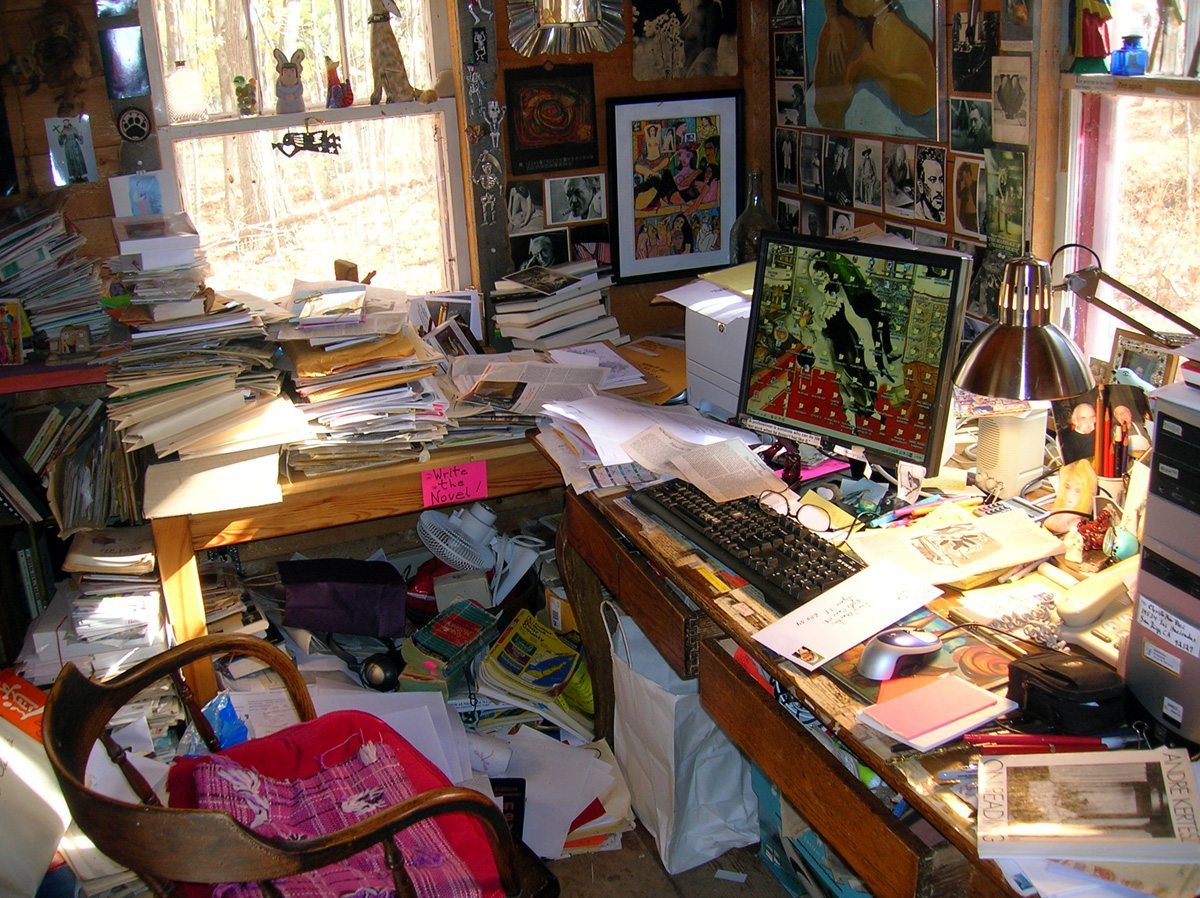
My desk is another reminder of a writer out of control. Coop-Chaos, I call it.

Back when I was fighting our hapless local newspaper, The Door County Aggravate (www.bleidoorcountytimes.com, open link to Blei at Large & Co., open ‘archives’ on right). BUT, no! I don’t want to go there again. That battle’s been won, lost. A dead issue, a dead newspaper at this point.

Let’s just say, that one of my suggestions to hold and increase newspaper readership (local, city, national),was they open the pages more, including the editorial, to better writers, better writing, more universal subject-matter that might appeal to, dare I say ‘the soul’ of the reader? Nature alone is a sure thing.

The New York Times succeeds in this area brilliantly with the occasional nature essays (“The Rural Life”) of Verlyn Klinkenborg, who appears right smack in the lead editorial column (always the very last editorial ) whenever the spirit moves him. And when it does, it moves me—and many readers as well, given the daily stench of bad news. A rural refresher. Smell the good air.

I usually get to about the second paragraph of one of his poems, I mean essays, and reach for my scissors. Clip, clip, clip…another keeper. Something else to add to the pile of stuff that surrounds this writer. Inspiration. It helps make the world a better place. At least in our imagination.

THE RURAL LIFE

How the Thunder Sounds

by
Verlyn Klinkenborg

For the past month, late-afternoon thunderstorms have coasted across this farm with an almost reassuring regularity. After three or four storms in as many afternoons, they seem almost domesticated — an aunt or uncle stopping in for a surly tea but leaving the air surprisingly refreshed in the aftermath. While the storm was building one day, I found myself thinking of new words, a new lexicon, to imagine the march of those storms. As the skies darkened around teatime once again, I could have sworn I heard crumpeting in the distance.

It is late afternoon as I write. There is blundering beyond the tree line. Soon the tuberous blunderheads trundle over the horizon; they begin to “wampum, wampum, wampum” until at. last they’re vrooming nearby, just down the valley. Or perhaps they’re harrumphing and oomphing, from the very omphalos of the storm. Onomatopoeia is such a delicate thing.

But as the clouds tumble into position directly overhead, the sound changes, as does the color of the day. Suddenly the air is grackling, dark and furious in its plumage. The lightning and thunder begin to come as one — ZEBU! ZEBU! — drowning out the wishing of the rain and the concurring of the wind, which turns the maple leaves white-side up. Hail begins to adder on the skylights, and soon the only light left in the world is the sickly green of the storm’s hunkering belly. The roar in my ear is the sound of the gravel road toshing away, worsing downhill and forming a lake on the highway. Water runs in revels and midriffs through the pasture, where the horses stand indifferent to the caucus around them.

And then, just like that it’s over, only a bumbling far to the east, a last snicker of lightning. The sun gloats in the sky, casting a gleam on the pasture where there was so much umbering and ochreing only moments before. The static electricity of the day has been discharged, and with it the linguistic oddness I have been feeling. The storm, I realize, has left me ravenous, hungry as a raven.

[from, the New York Times 7.6.09]

Dark Comes

by
Verlyn Klinkenborg

I don’t go looking for the places of deep comfort on this farm. They call out to me. Why does the mounded hay in the horses’ run-in shed look so inviting? Why does the chicken house — warm and tight and brightly lit — feel like a place where I could just settle in? I climb the ladder to the hayloft and the barn cat watches me warily from his redoubt in the hay bales. I feel like getting my sleeping bag and joining him.

Night comes, but the fog comes first, dragging the last light with it across the hilltops. The leaves have started to fall — just ones and twos, but already scorched into autumn colors. It is still too warm for the woodstove, the kind of evening that feels like summer in mourning, though without any real sadness. On a night like this, “grieving” sounds like the noise the wind would make if it got into the attic.

Real autumn is a long way off yet, no matter what the pumpkins say. The sight of them at the farm stands seems to jerk me forward, and I am not ready. I want to consume the particulars of the day ahead of me, one by one.

I was away from the farm for two days this week, and it sprang ahead without me. The bees, uproarious around the hive-mouth when I left, are nowhere to be seen in the dusk, though I know they’ll be out again in the morning.

That hive is another place of comfort. I don’t know whether their labor feels like labor or whether necessity is joy to them. I never see the bees coming and going without wondering what so much kinship means. I loved the education Merlin gave the young King Arthur in T. H. White’s “The Once and Future King,” turning him into creature after creature. I teach myself the same way every day I’m at the farm.

[NYT 9.17,2010]

Hickory Rain

by
Veryln Klinkenborg

It’s well before light, and I’m listening to the rain, watching every now and then the flicker of headlights coming down the hill. I no longer have custody of Ethel the border terrier, so I’m up early on my own.

She was itemized in a divorce settlement and now lives in Iowa, where I know she’s happy. I hope she misses me, but not nearly as much as I miss her.

Without her, the rhythms of the day ahead are different. Somehow there’s more time for the horses, which is perhaps why Nell the mustang let me catch her when the farrier was here. At first she shied away, to keep up appearances. When the other horses had been trimmed she presented herself to my arms, and it was a much more beautiful day after that.

I have new chickens — layers eight weeks old. When they were living under lights in the mudroom as chicks, I made a practice of picking them up, those that would let me. And now when I enter the poultry yard, I feel like a one-man midway at the chicken fair, birds standing in line waiting to be picked up.

No good can come of lifting chickens. I can almost hear my dad thinking that, though he is gone now, too. And yet the birds churr and cluck, and I leave the yard happy.

The chicken house my dad and I built soon after 9/11 has’ begun to sink on one end, thanks to the woodchucks. That gave me an excuse to buy a bottle jack, which I’ll slip under the sill and, with it, jack the house back to level. The place will feel more trim, and it will keep water from running out of the chicken waterers, which will matter once the freeze begins.

It’s hard to explain where happiness comes from when so much has been lost and misplaced and set aside. But come it does. This is one of those mornings when I think I have a farm just to surround me while I work. The chickens will be darting in and out of the rain, the fall of hickory nuts will continue, and the horses will stand around an upended hay bale in the shed on the hill, looking as though they’ve got a game of three-handed pinochle going.

[NYT 10.19.10]

appreciation | recuperation | home again

Appreciation

Recuperation…

Home Again

by
Norbert Blei

Well, the ‘third part of the journey’ (operation bad esophagus: enter, probe, cut. remove, stretch stomach, stitch…close) completed and successful well over a week ago.

Now for recuperation. Recovery. Putting some meat on these bones.

But not before ‘thank you’s’ to everyone for the healing, the hope, the love sent via prayers, visits, phone calls, cards, gifts. Family and old friends, local ministers (Rev. Michael Brecke and Rev. Phil Sweet, my two favorite men-of-the-cloth), shaman, astrologers, Native American medicine folk, meditation people of every belief. It all worked. Blessings.

Yes, all the bigness of heart, wonder of words worked—plus the golden hands of surgeon, Dr. James Maloney, University of Wisconsin Hospital, who walked into my room one week after the operation and said I was ready to be released. Everything in order. The cancer gone. A new order/pathway intricately cleared to consumption, digestion, better health. A new man.

A writer with a loss for words ? Guilty. How to honor and thank a man, a surgical artist, for handing your life back to you with a smile?

“I heard you were the best,” I said, voice breaking, eyes watery…

“It’s not me,” he said. “It’s the team.” Teams of physicians I encountered from day one, months ago, at the UW Madison facility. I am forever thankful to all of them.

To leave every aspect of ‘hospital stay’ behind, especially the air one breathes in such a state of lingering anticipation of confinement/release, the order of odors from medicinal to stale atmosphere…and to then suddenly walk away (be wheel-chaired away) from it all…find oneself sliding the car windows open on a journey back home…freedom, alive again, inhaling/exhaling deep gulps of rural Wisconsin pastures, fields, woods, wind, the possibility of thunder showers, the freshness of air breezing off lakes and rivers…oh sweet on-my-way-home-Wisconsin…dazed by cows and cattle, red barns, white farmhouses in the shade of old oak trees, corn fields, tractors turning up earth, hay bales, and horses lazily grazing in a bucolic dreamscape drifting into nap-time…my i-Pod plugged into Bach…my partner, my woman, my caretaker, Jude at the wheel, glancing at me every minute…”You okay?”…a pat on my hand. The smile I feel on my face, answer enough.

To finally turn down the road I call mine, the road I can’t wait to be walking (maybe tomorrow?) again…to pull into the driveway, welcome the new lawn compliments of my son, Christo, and daughter, Bridget, after the new well destroyed my yard… Ah, the trees, the woods, the bird bath and feeder, my old rocking chair on the deck, the flowers in bloom…the very house itself, which I truly love, a perfect habitat…every room—kitchen, kitchen nook, dining room, study, upstairs bedrooms, cellar—every Persian rug, every piece of furniture, and pottery, all the art objects that hold my attention…my books, my beloved walls of books, soooo good to be back in my chair, everything I need within reach–pens, notebooks, scissors, stapler, magazines, newspapers, films, current books I am reading…phone, phonograph, i-Pod dock, television…all my clocks tick-tocking and striking (all the wrong time). Who cares? The time is now.

Recuperation is a long word that stretches out for who know how many days, nights, weeks, months…? I welcome it, however long it takes. Just a little improvement each day will be fine.

I sleep the first night in my La-Z-Boy, propped up at a thirty degree angle (as I must now for the rest of my life) and sleep good, well, perhaps even profound.

My eyes open to early morning sun light drifting along the very tops of the beautiful white birch and maple trees across the road. I love to watch this play of light at dawn…how it drifts slowly down the tops of trees, from branches to trunk as the sun climbs higher above the great lake, and the smaller one at the end of my road. The front door open to cool morning air and the sound of birds. No one on the road at this hour. Nothing…nothing but the serenity of silence…natural sounds.

That moment comes when I dress…a chore in this recuperation mode. Every move takes forever, brings a little pain. But I gather myself together the very first morning upon my return from the hospital and take to the road.

The road which is already undergoing subtle change. The cool shadow of fall in the air. Leaves and grasses no longer expressing the bright freshness of May or June green, but grown old, tired, discolored, on their way to russet, amber. Some of the branches of the maples already exhibit transforming shades of green-yellow…green pink and bright red. Autumn, stealthily working its way across the landscape.

My roadside, ditch garden has turned to mostly white Queen Ann’s Lace bobbing in a gentle breeze, some straggling blue corn flowers, purple clover, spikes of golden rod, and here and there black-eyed Susan’s taking a peek at me.

A huge V of honkers fly over me and makes my day. I catch myself about to wave and say to them on high: “I’m back! I’m back! Good to see and hear you guys again!”

So caught up in the moment, I am amazed to find myself completing my usual long walk (which I have not done in months), and on my way home again.

As I approach the gravel driveway, I am aware of Jude in the kitchen getting my ‘liquid diet’ breakfast of juice and cream of wheat ready on the table in the nook. We will sit down together and eat, laugh, gossip, tell stories, make plans.

Of all those in my thoughts throughout this health ordeal, she reigns supreme. I could not have made it this far without her ‘intensive care.’ All the time and energy she has devoted to me day after day, night after night, hospital after hospital. All my moaning an groaning, ups and downs. She has a better perspective on so many more things in life than I will ever have. I envy sometimes her pure joy in daily life.

One small measure of thanks: I recently purchased a print for her by Mary Hamilton called “Simple Pleasures” at a local gallery. Every image in the print speaks of her. I wanted her to know that , “simple pleasures” is one of the things I most love about her…and all that she has brought to my life these past years.

I am reminded too of our many simple picnics (“a loaf of bread, a jug of wine and thou singing in the wilderness”) which we have shared in our favorite Door County parks. I long to be well enough, soon, to get back to that…to stop at Annie’s TOP SHELF gourmet shop in Sister Bay, buy a loaf of crusty fresh French bread, small portions of some exotic cheese, a bottle of wine…and head to a picnic bench in Peninsula or Newport Park.

I am reminded too of my friend Reverend Phil Sweet’s life-long search for meaningful religion in our age (from Christianity to Buddhism and beyond), a faith he has honed into six simple words as he continues his personal search: “To love and to be loved.”

If I were to leave the planet tomorrow, may my last expression be a smile upon my face.

It’s all good.

It’s that simple.

Norbert Blei | Photo: Jude Genereaux

roadside gardens, birdfeeders, wind chimes, i-pods…silence


Roadside Gardens, Birdfeeders, Wind Chimes, I-Pods…Silence

(Notes from No-Man’s Land #3: On the Road to Recovery)

Though I’ve never been much of a gardener, flower or vegetable, I appreciate their presence in my midst, whether from a distance or visiting friends with flower gardens glowing in color throughout the seasons, not to mention gifts from vegetable gardens–asparagus, beans, spinach, lettuce, green peppers, onions, strawberries, raspberries…and oh those sweet juicy red tomatoes.

But it’s the flowers I find especially appealing every year down my road, which I still can’t walk the distance I’m accustomed to…still too exhausted to reach my usual turn-around spot, heading back to the house.

I missed my old neighbor, Charley Root’s field of sweeping, deep-gold coreopsis waving hello in the morning breeze this year. Never saw one prairie rose. Or one yellow lady slipper. But the daisies are dancing as I walk by. The spring trillium, long gone, remembered in my short walks. The delicate Queen Anne’s Lace is beginning to make its presence, and mullein plants reaching up to bloom as well. The myriad of other small flowering plants/weeds which I could easily identify if I could only remember each name or looked them up in my wildflower books. I seem to prefer for now instead their nameless colorful shapes, their small moments of surprise, pleasure and harmony along my wild roadside . If only the town would stop mowing them down just as they reach perfection. I wish for more summer mornings of sweet scented clover—a wild fragrance most divine. And dearest to me, of all, a blossoming of fiery, petaled tongues I await each year: two thick patches of tiger lilies bursting in the late afternoon sun, flowers which I ‘protect’ with a sign: DO NOT CUT. (Always remembering my heated argument years ago with the town’s roadside maintenance man who hollered back at me from the tractor as he mowed them down: “Dem ain’t flowers! Dem is weeds!”)

I speak then for the presence and preservation of ubiquitous roadside gardens that give each year freely, in full measure, scattered bouquets of color, form, and scent, just waiting to be ‘taken in.’ No gardening required by the onlooker, only an occasional prayer for rain in a dry season. They are my true love. The natural, the always surprisingly predictable, which sustains me spring, summer and fall—even winter, with the skeletal sculpture of the milkweed plant, reaching above the dead fields, each plant graced with fresh, soft, white snow beckoning a moment of beauty and remembrance in so spectral a season. I speak too beyond the private pleasure of my own roadside garden. There are those times when I take to the car for the pure pleasure of ‘the hunt’– seeking certain swatches of wild flowers in bloom at those certain times when I know exactly where to find them on certain Door County back roads, which will remain in the privacy of my own watch.

Often these days, going or coming from the coop, I pause for a momentary rest in my old rocker on the deck. I contemplate the afternoon, the early evening …checking on all manner of natural things which give me pause, give me comfort–the sunlight, the trees, the wind…especially in these trying times of regaining good health and energy. I wait and watch for the birds at my feeder. Whatever their nature and movement, I’m glad to see them stopping by at my place. I delight in robins splashing in the bird bath. Wary woodpeckers checking in. The constant going and coming of chickadees. The plaintive call of mourning doves pecking at cracked corn on my gravel drive. Such pleasure and delight of feathered creatures, their airy freedom of wings which I sometimes follow to the tops of trees, or the overarching blue, where I might catch a solitary white gull, aglow in the sun, heading toward the lake down the road from me. And just yesterday, a sudden flock of goldfinches lighting up the yard, flashing their irresistible color as they descend upon my feeder like a blessing.

Sometimes these natural meditation moments on the deck are enhanced by wind chimes…a Zen call to silence impossible to describe except for that delicate sound in the company of soft breezes which take one to that solitary home again, every bare room and window open to peace, serenity, a sanctuary of nothingness. Nothing more, nothing else. Only now.

There are times too, when today’s technology might rear its ‘disturbing’ head, calling for a different form of meditation: an escape into music: classical, jazz, folk, opera. Mozart to Miles, Bach to Brubeck…pop, big bands…James Taylor, Maria Callas… I admit to bowing to the times, owning a magic i-pod with AM/FM (the daily pleasure of public radio), and presently more than five hundred pieces of music, only a touch away. I fix my small headphones. Go to ‘albums’ on the pod.. Hit ‘shuffle’. Close my eyes…say goodbye for now to the birds, the green trees, the blue skies, and let the music wash over me…carried away by beautiful voices, lyrics, instruments, rhythm…where time disappears.

And sometimes. late afternoons, I go into the house to rest, to try again to ‘nap.’ I climb the stairs to the upstairs, front bedroom–my old studio/office which I occupied for years when both kids slept in bunk beds in the same downstairs bedroom. A small room facing south, two small windows level with my desk, a funky little room I loved to write and paint in (actually a dormer) with all kinds of strange angled walls and filled with light.

I stretch out on comfortably on my back, arms behind my head, eyes focused lazily out both windows open wide to the wind, taking it all in…the tops of trees, blue sky, rolling clouds, bird song…everything out there in fervent conversation …maples in dappled sunlight talking to the birch, beech, oak, and ash, waving to one another, swaying in harmony, joyfully turning over their leaves to an under-light of glowing sun, flashing one way, then the other, tangling the stems of playful branches as stronger gusts of wind take them by surprise and carry them even higher to the heavens…the pines ponderously in place, stifled sentinels to the spectacle of the play of light and wind.

All this invites me into a silence, the language each season speaks, to further define itself from wood pecker chatter to howling winter wind…to the ease of slumber when a spring rain may patter on the roof…then a deeper slumber as I drift off to maybe Europe Bay, down the next road from me, where the gentle summer-blue waters of Lake Michigan lap the shore, ripple the sand in their old lullaby rhythm of back and forth, in and out, here and now, today and tomorrow… and tomorrow and tomorrow… –Norbert Blei

father’s day


FATHER’S DAY

On this Father’s Day, this father chooses to honor his children, now both adults with lives and families far away from here. Yet here, this house, this coop, this woods, this road down to the lake, this place holds my fondest memories of them. I can almost hear their childish voices, almost see them on a tree-swing that once hung from an old maple tree near the road, almost see my son throwing a basket ball into a small, much too low, ring that still remains attached to the garage today…and almost make out the strike-zone I once painted on the outside of the garage door, where my son and I pitched a soft or hard ball to each other: “Batter up!” He was tireless…I was always exhausted. And I still see and delight in my daughter living her life full in the imaginary world of dolls and babies, taking to them, singing, pulling them in a wagon down the road…playing house.

I have written very little about either my son, Christo (Christopher) or my daughter Bridge (Bridget) in all the words and articles, stories, poems, books I’ve penned since I first began to write seriously around 1961. I’m not surprised by this. But I am aware. I don’t have any explanation for this—then again, if I may speculate…

Somewhere in my crazy ethnic, Eastern European origins and blood lines, I harbor the gene of ‘secrecy’. I saw it in grandparents, parents, aunts and uncles…from early on cautioned: “Don’t tell anyone!” The Catholic church with it’s rituals and ‘confession box’ (an apt metaphor) only enforced this darkness within. Just between me and the big guy up there. Nobody else need to know. And when writing first began to take hold (late high school, early college), it was all about secrecy, privacy, finding yourself in an imaginary world that no one need know—till you felt the need to share the words in publication. A hard lesson.

To this day, I harbor more secret rituals about my work and life than anyone would imagine. I never show a manuscript to anyone prior to publication other than my publisher and/or an editor.

Most perplexing, confounding, almost unexplainable (undoubtedly a big factor in the loss of a long marriage) was how ‘the secret’ becomes ‘the secret life’ which is impossible for the writer to reveal in any other way than words on paper.

All this to explain the double-life. In my case, the middle class father outwardly living the life of wife and family and all that it entails to insure loving care, proper parenting, the straight life and above all, ‘protection’—from the other life of creative craziness within where freedom reigns and the writer is most alive, constantly on the edge of bursting out, ready to sacrifice anything (marriage, children, job, profession, religion, middle-class friends and values) to remain forever in this state of grace, his true self.

Bless you both, my son, my daughter, for all you have brought to my life.

Love,
Dad

Bridget’s Bouquet

June 30I have no time, it seems, even for flowers along the road. Those weeds already in downy fullness to match the full moon last night. The orange and yellow hawkweed dotting the roads and fields in perfect free¬style flows of color. And the white daisies, singularly, the most beautiful petaled flower. These my daughter secretly gathers in a small bouquet for my desk. Through the white daisy we both speak summer, though the act is one of silence. I will enter the coop, usually in the early shadows of morning, flick on the desk light, and there, in a white vase near the typewriter, a small bouquet of daisies. And that will set the day—a child’s gesture of unexamined love.

Games Upon the Road

October 30I’ve played these games upon the road with my son for more than 10 years now: baseball in spring, football in autumn, hockey in winter. In fall, especially, I’ve watched his shadow grow into mine in the always setting sun behind his back, felt his arm strengthen and his pass aim sharpen. He plays to win, to seek a perfection beyond the old man, while my passes grow shorter, and my runs are all too soon out of breath. I play to be outside in these dwindling hours of autumn, to hear the missed pass rustle through the leaves, to consume the sky above his head in such a glow of gold and lavender, the softest flush of pink. We toss passes till the light is gone, till the ball must be arced considerably toward the receiver’s hands. Until I call “time to go in,” knowing this fall may well be our last chance at autumn games, the shadows having merged and boyhood disappeared.

[from DOOR STEPS, Ellis Press, 1983]

The OLD MAN, looking back, looking forward.

« Older posts Newer posts »

© 2026 N.B.Coop News

Theme by Anders Noren adapted for M.etropolis by RavanHUp ↑