N.B.Coop News

Breaking, broken…Good, bad…Old, new…Global, national, local…Facts, figures, fantasies…Letters, notes, opinions…All the news fit / unfit to post, print, scatter… Norbert Blei – publisher & editor | Monsieur K. – managing editor

Page 5 of 7

notes from no-man’s land, week 4

Notes from No-man’s Land, Week 4

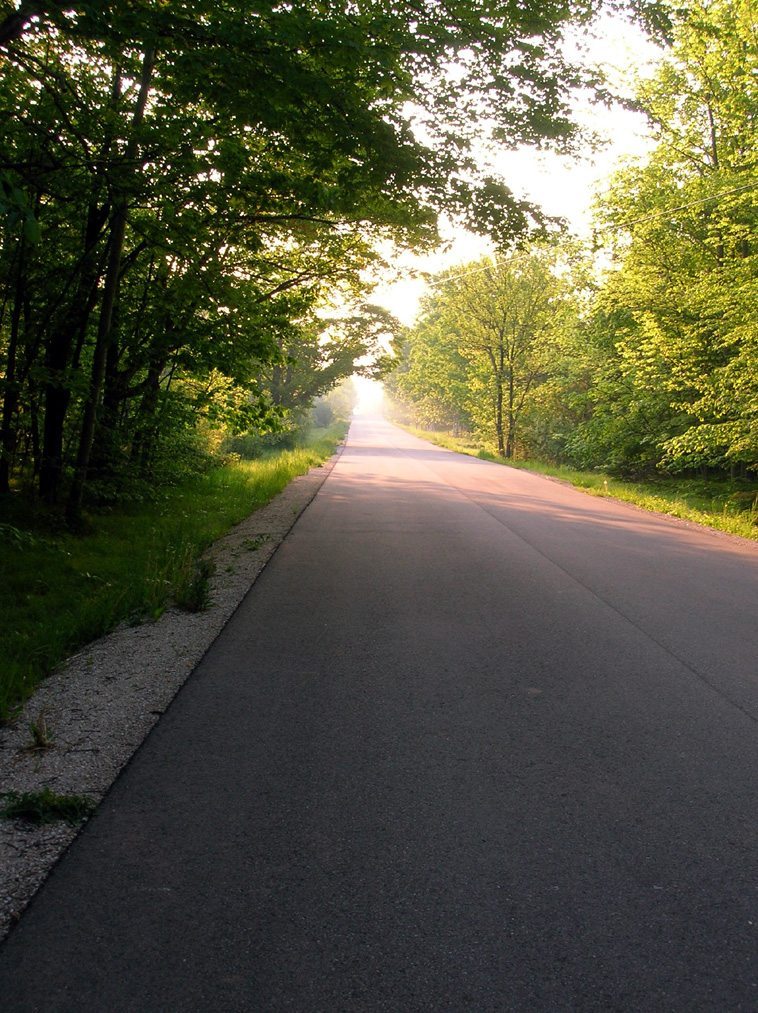
Today I try to walk my road again toward the lake at daybreak, at least part way. My energy level remains low, my spirit in high gear.

I am greeted at the door by moist clay pots bursting with “Mexican Red” geraniums up and down the wooden steps, the work of my partner Jude, who sees to it that color return to this place in the woods, window boxes, deck, garden, after a season of winter white. She makes the house sing in spring.

I am reeling in images of RED, RED, RED GERANIUMS… remembering mornings in Mexico, New Mexico, a sun-drenched landscape almost surreal.

The air is cool still, with a hint of mist, humidity waiting for mid-day.

I take the last step down, touch the good earth, one foot at a time in the brilliant green grass…pause briefly in the yard…inhaling, bathing, showering, swallowing, gasping, drinking in the air saturated with the fragrance of three old lilac bushes.

Drunk again in lilac-time…can’t get enough…give me more, more, more…hang in there, please, yet another day…deep purple, lavender, white…too soon, too soon the lilac light swoon dissipates into the thickness of summer.

The road greets me with the first rays of morning sun. I step into it, onto it, away …past my green woods, my coop, waiting for me, tucked deep old trees, hidden amongst the maples, beech, and birch at this time of year.

Bird song: a chorus of robins, one squawky blue jay, a wren, my early morning woodpecker drumming up the sunrise. Clouds of the bluest forget-met-nots running alongside me in the roadside ditch…a few trillium still trumpeting their white presence…and ah, ah, the sweet smell of wild clover. But no sign yet of the prairie rose, a particular favorite…

I make it to the old garden, pause awhile, remember seedlings sprouting, the rows of vegetables…the agony and ecstasy of growing anything in this northern clime of stony earth…the garden gone back to weeds and wild flowers…no longer tilled by me, worked over and into spring, summer, fall… religiously, lovingly, by the woman once my wife, mother of our two grown, beautiful children living their own lives far from here…the marriage ended amicably, gone our separate ways almost ten years now. I see her bent over in the garden still, attending each growing plant…miss the snap beans, green beans, potatoes, lettuce, kohlrabi, beets, squash, green peppers, egg plant…and oh so fresh, red sweet tomatoes.

Crossing to the other side of the road at the end of the garden, under the shade of a towering old maple…I resume my inspection of the ditch for any evidence of blushing pink prairie rose…check the progress of two grand sweeps of tiger lilies that grace my morning walks in season…discover them still reaching, thrusting toward blossom.

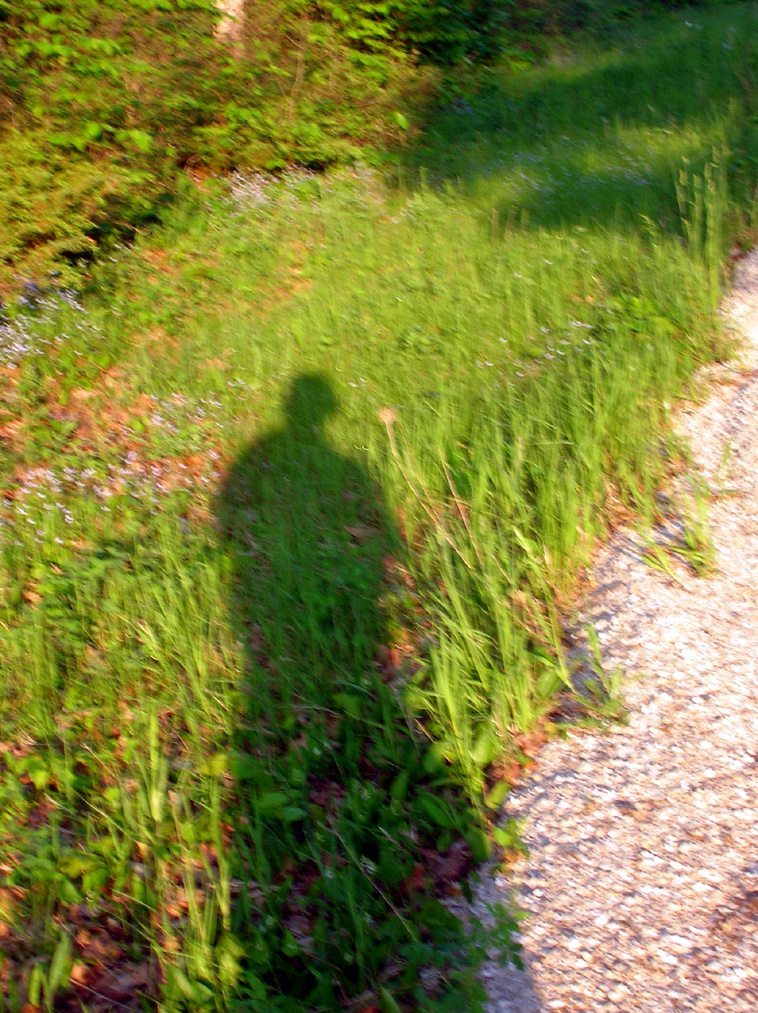
The sun behind me, lighting my way back home, I walk slowly into my own shadow, moving us both into another day.


the solitary walker


Drawing from the sketchbooks of Charles Peterson.

The Solitary Walker

A walk with someone else beside you, in front of you, behind you, qualifies your
steps, your direction, your meaning and mood.

Though the walk to the lake may be familiar, it is never the same.

Time of day and weather conditions, though unmentioned, immediately affect the
walkers.

What one sees, though it be familiar, is also not the same.

A walk, to be most meaningful, most meditative, most astonishing, must be
solitary.

Talk destroys quiet perspective.

Thinking, the mind in a muster of images or memories to be talked out,
diminishes reflection and surprise over the most mundane rock, weed, bird, tree,
or farm in the landscape that seeks the solitary walker’s attention.

The delicacy of both sound and silence are lost to walkers.

The walker alone becomes these.

[from DOOR STEPS, Ellis Press, 1983]

Editor’s Note from No-man’s Land: What I miss during these says of illness are my morning walks. My energy level barely gets me from the house to the coop without tiredness setting in. I sit at the desk and view the road from my window, wishing to be on it, breathing the crisp air. To leave the house and meet the new day on the road as the sun is breaking. To sense the light washing down upon you brightening your every step. Sounds—the whole symphony of spring. Getting inside the new day as it opens and begins to shape the words you will write today. –Norbert Blei

readings by norbert blei & music by jim spector

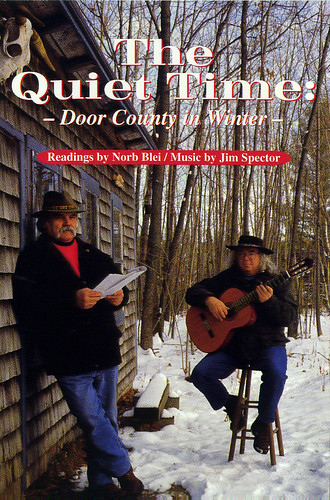
Readings by Norb Blei & Music by Jim Spector

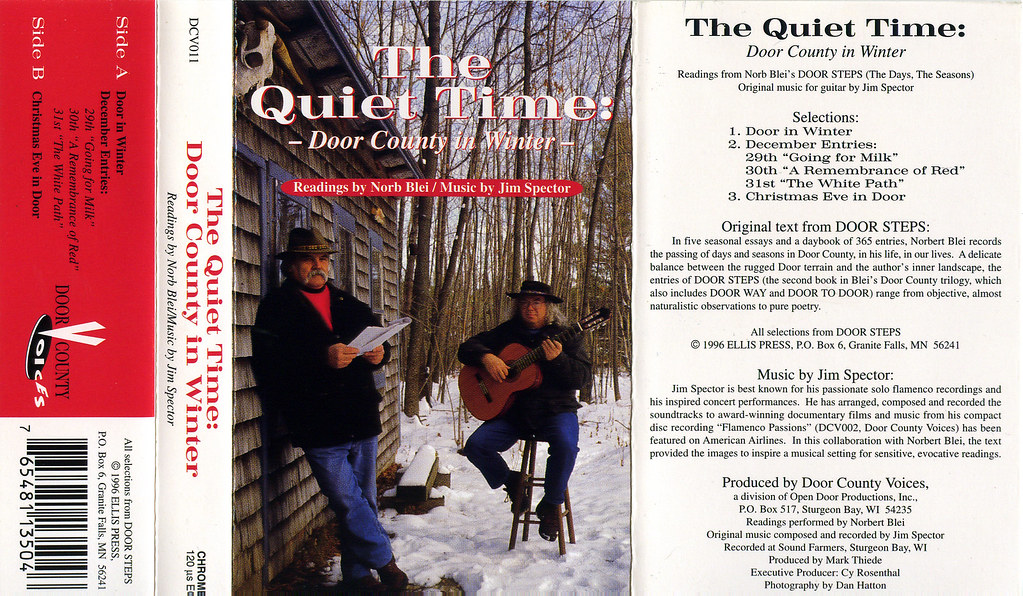
Tracklist: Door in Winter: December Entries: 1. 29th Going for Milk 2. 30th A Remberance of Red 3. 31th The White Path 4. Christmas Eve in Door

All selections from DOOR STEPS © 1996 ELLIS PRESS, P.O. Box 6, Granite Falls, MN 56241

The Quiet Time: Door County in Winter. Readings from Norb Blei’s DOOR STEPS (The Days, The Seasons) Original music for guitar by Jim Spector.

In five seasonal essays and a daybook of 365 entries, Norbert Blei records the passing of days and seasons in Door County, in his life, in our lives.

A delicate balance between the rugged Door terrain and the author’s inner landscape, the entries of DOOR STEPS (the second book in Blei’s Door County trilogy, which also includes DOOR WAY and DOOR TO DOOR) range from objective, almost naturalistic observations to pure poetry.

Jim Spector is best known for his passionate solo flamenco recordings and his inspired concert performances. He has arranged, composed and recorded the soundtracks to award-winning documentary films and music from his compact disc recording “Flamenco Passions” (DCV002, Door Couniy Voices) has been featured on American Airlines. In this collaboration with Norbert Blei, the text provided the images to inspire a musical setting for sensitive, evocative readings.

Produced by Door County Voices, a division of Open Door Productions, Inc., P.O. Box 517, Sturgeon Bay, WI 54235. Readings performed by Norbert Blei. Original music composed and recorded by Jim Spector. Recorded at Sound Fanners, Sturgeon Bay, WI. Produced by Mark Thiede. Executive Producer: Cy Rosenthal. Photography by Dan Hatton.

Much more on Norbert Blei can be found on his web sites:  Basho’s Road & Poetry Dispatch & Other Notes from the Underground

listen to Norbert Blei & Jim Spector | 29th Going for Milk

Editors note: This recording was originally released as cassette and is not longer available. Norbert Blei was so kind to send me one of the very last un-played tapes. Digitalized as mp3 in 320kps | 44100hz | Stereo quality by Markus Mayer in Vienna, Austria.

If you are interested in buying this digitalized cassette please click here…

life in the rural…

Life in the Rural—an Update:
May Day…Flowers, Faith, A Photo Essay…Mostly

Yesterday, May 1st, neighbor kids, the Brandts, quietly left a small bouquet of colorful flowers on the writer’s door as they do every May Day, brightening the moment considerably. Calling attention to the ordinary life, the quiet gesture, simple beauty, the greater good.

The writer prays this particular fish tug, minutes from where he lives, will always be docked in this harbor. Its very name gives him great joy.

Now here comes, there goes the ailing writer, May 1, off to the coop, (rough days ahead, for the next five weeks), waving “Hello,” “Goodbye”…with faith in the word, uppermost in mind…determined that all his stories ”be continued”…

great women of the clearing: in memory of emma pitcher 1915-2010

I would like to hit a number of notes with this piece. Today is Earth Day—what better moment to celebrate the life of an old friend, former Clearing student, Emma Pitcher? Then there’s The Clearing itself, where I have taught writing almost every spring since the 1970’s, and where my own life has been considerably enhanced because of the true nature of this place.

I received a call on Tuesday afternoon that Emma Pitcher had died. I had lost touch her with the past few years, but she always came to mind whenever I recalled earlier classes. Which is more frequent that one would imagine.

Always it’s the students. The uniqueness of each one whatever the age or gender. What they bring to a class setting. What I earn from them. Whatever writing spark I may be able to provide for each of them.

There was a hint of the old ‘school-marm’ about Emma that took a while getting used to—for both me and other writers in class. A touch of the scold. The right way and the wrong way from every thing to the choice of words, Latin names for plants, to photographing a flower. She was more than a little bit above it all—in education, intellect, life-experience, seeing/doing things her way. But once you got past this—she was pure gold. Her laughter was infectious. Her intimate friendship knew no bounds.

Her particular expertise was nature: flowers, birds, trees, the whole earth. She loved the Clearing, the Indiana Dunes, the entire Midwestern landscape.

I’ll leave the details of her life for her official obit. Personally, I was aware she was divorced very late in life and this was a wound that would never quite heal.
Only nature—and writing offered any balm.

She came to my class already an accomplished nature columnist for the Kalamazoo Gazette. All I was able to do was suggest she start publishing her columns as books…plus provide some direction through fields of poetry, which would eventually loosen some her prose, give her more wing-span. For this, she was eternally grateful.

I love smart, sincere, real, adventurous, humorous, open women—both young and old. Especially older women with life experience, love of art and nature, and a spirit that can rise to any occasion.

Emma didn’t need the feminist movement. She knew exactly who she was and her place upon the earth. She left her mark in words, in everything she touched, in every friend she made and held fast to the very end.–Norbert Blei

Illustration by Elizabeth Henderson

Verbs for Birds

by
Emma Bickham Pitcher

What verbs would you use to describe the move¬ment of birds? We all know a duck waddles because his legs are situated so far back on his body. And a mute swan trying to get his twenty-five pounds airborne has to thrash and thrash the water heavily. What other verbs immediately remind you of some particular avian experience you have had?

The word bounce connotes a sprightly reaction— the thing a tennis ball does after being hit by Pete Sampras or Martina Hingis. I think a saucy-demeanored black-capped chickadee bounces—he levitates in defiance of gravity. Its almost as if there were built-in springs in his legs that make possible his fast takeoffs. Bounce has other meanings relating to bad checks, night club guards, office dismissals, illness recoveries, but I like best to think of it describing the effortless verve of a chickadees departure from a feeder.

Some bird groups explode, really frightening an unaware passerby. Ruffed grouse and Gambel’s quail broods, cornered or threatened, will burst out suddenly from under one’s feet—birds everywhere, flying in a dramatic distraction display.

Hovering is fascinating avian behavior to watch. You wonder if you re seeing things. If an airplane were to try standing still on air, it wouldn’t work; its aeronautical dynamics would be destroyed and it would become an FAA statistic. But some birds—from hummers to rough-legged hawks, including terns, kestrels, and kingfishers—can hover, beating their wings rapidly to keep the same position while checking out a possible meal. Hummingbirds, the most successful of all hovering species, seem to stand still as they suck nectar from a flower, maintaining the position with as many as seventy beats per second, wing beats too fast for human eyes to see anything but a blur. A belted kingfisher poises, wings beating hard; then, when ready to dive, he closes his wings tight to his body and plunges into the water. He may also perch motionless in a conspicuous place, waiting for a meal to appear before he dives.

Eagles may dive from high in the air, making spectacular plunges several feet into the water. Gannets, too, do high dives, fifty feet or more, when in search of quarry.

Thornton Burgess, and other children’s authors who anthropomorphised many animals, wrote of Sammy Jay strutting and swaggering. I think swoop is a fitting verb for him. Many birds approach feeders in short reconnaissance stages, making sure the runway is clear, before making the final approach. But not the blue jay. He swoops rapidly, gulps down one to fifteen seeds, and vanishes, scattering smaller birds willy-nilly.

Pounce is another descriptive but useful verb describing particular bird movements. A robin will cruise around a lawn in dignified fashion, head cocked, but when the right moment occurs, that yellow bill goes after the worm with considerable strength and style. He pounces on it. Similarly, a perched barn owl or great gray owl studies the ground intently, and then, with a graceful whoosh, the bird plummets down, and another rodent becomes dinner. Kestrels on telephone wires have similar performances.

What is it to soar? Is it to float through the air, wings rigid, stiffly extended, body hardly moving, taking advantage of wind currents to maintain or increase altitude? A barely discernible rocking or tilting from side to side helps maintain position. To see hawks endlessly circling in larger and larger arcs as they rise on thermals, the heat currents coming up from the land, is always mind-boggling to me.

Anyone fortunate enough to find adult birds feeding their young experiences perfect examples of begging. With mouth agape and wings flapping wildly, the fledgling entreats a harried parent to feed him immediately. One can almost feel saliva running, so violent is the activity.

During May migration, enjoying a small flowering tree alive with wood warblers—black and white and yellow flashing everywhere—is to experience the act of flitting. We were watching such an enchanting tree once, dashing back and forth, binoculars up and down, shouting excited “oh looks”, trying to get one set of wings in focus, when an unknown cartoonist s prototype of an elderly female birdwatcher in tennis shoes said to us;

“Forget your binoculars. Stand still and just watch for field marks.” Her advice worked. We let the birds do the flitting.

A nighthawk in dramatic courtship display flight booms with his wings as he makes a spectacular plunge from high in the air. The sound is the rapid rush vibrating the feathers.

Birds that spend most of their time in trees generally hop with both feet whether in the tree or on the ground. This is tiring because the entire weight has to be lifted every time. Ground nesters such as meadow-larks are more apt to walk, one leg moving at a time, and the entire weight is never suspended. Brown creepers and white-breasted nuthatches creep up and down and around trunks while woodpeckers hitch their way up.

To see a flight of gulls leisurely beating their way down a wind-driven, sunlit lake is a pleasant sight, evocative of summer days. The effortless flight is the evidence of having a complete set of all the necessary equipment and having it in perfect working condition.

A male ruffed grouse drums with his wings, using the whirring sound to stake out his territory, repelling other males and attracting females. Many birds glide effortlessly into landings, making no body movements, just coasting downhill, wings extended, legs down ready to make contact.

Black skimmers skim and roadrunners run and. . .

[from RAMBLINGS, Reflections on nature by Emma Pitcher, illustrated by Elizabeth Henderson, Beech Leaf Press, 2001, $11.95]

Emma Bickham Pitcher’s serious nature interest started in the early 1950s in the Indiana Dunes where she began bird and flower watching. Moving there in 1980 from Chicago, she wrote and taught about the dunes natural features, enjoying photography and field work. Since 1987, she has devoted many hours to the Kalamazoo Nature Center: studying the trails, teaching and writing. A naturalist at a 180-acre private nature preserve and a licensed bird bander, she took courses at Michigan State University and Western Michigan University.

An Illinois native, Pitcher raised a family and then worked at the University of Chicago. At retirement, she was Dean of Students of the Graduate School of Business. Her writings include Up and Down the Dunes, Of Woods and Other Things, and articles in midwestern Audubon publications. Over the years, various awards in recognition other volunteer activities have come her way, including those from the Michigan Audubon Society, the National Park Service, and the State of Indiana Order of the Sagamores of the Wabash.

Emma Bickham Pitcher | Photo by Norbert Blei
the way of old

Photo by Norbert Blei

The Ways of Old

Through the years I’ve been called a curmudgeon, a coyote, and worse in these parts.

Once they even took my job away as local writer–when writing about something used to matter around here.

But all I was suggesting in the onslaught of overdevelopment was preservation.

I pined away for years at my old friend Ed Abbey’s sense of time: “Why can’t we just leave things the way they were?”

I thought of that again today driving the sunny backroads of the rural landscape I’ve come to love…checking up on things: hawks high on trees, crows in cantankerous chatter, horses standing at attention, a farmer leaning on a fence post bound to nothing…

I was looking for confirmation, signs of the way it used to be.

For years I’ve been bemoaning the disappearance of my favorite harbinger of spring: maple syrup time. Tapping the old trees. Cool nights, warm days. The sap dripping into metal buckets. Another lost way…

Something almost prayerful in that sight.

Then, there they were…

Glory be to buckets of pure maple sap.

–norbert blei

Photo by Norbert Blei

a man on a bench

INTRO/Editor’s Note: I was fortunate to develop as a writer in the city of Chicago in the 60’s and 70’s when newspapers were the voice of the city. Every off-street, neighborhood, bar, ethnic group, character, restaurant, political ward had story potential, and thoughtful editors took you under their wing and saw to it that your word ‘of the people’ be celebrated on its pages.

I was even more fortunate in that almost every editor I worked with on city newspapers and magazines (especially the Chicago Tribune, The Chicago Sun Times, and Chicago Magazine) let me do any story that interested me. I didn’t need the approval of a board of editors and managers. I merely called from the street…let’s say, John, at the Chicago Trib…and told him: “I’ve always wanted to do a story about guys who sit on benches in city parks all day. I think I found one.” The answer was always: “Go ahead.”

Fast forward from Chicago then to Door County now, where I have lived a long time. (Still with a lot of Chicago in my blood.) It’s an unusually balmy early spring here in this rustic, rural northern neck of Wisconsin. About mid-afternoon yesterday I went over to a place called Ellison Bay Bluff Park to check on a spectacular view: the ice moving out. I lingered a long while in the silence and beauty of watching blue water return.

When a stranger stopped to talk I handed her my camera. “Take a shot “ I said, “for my son and daughter. But take it from behind me, not in front. I want them to know I’m okay. Still a dreamer. And that I’ve reached a certain stage in life. I’ve become a classic bench sitter.” –norbert blei

A Man on a Bench

At four every morning Innocenzo Bonelli is up, partly because of the pain, partly because a ninety-year-old man does not sleep long. He eats in his room at the Wells Grand (“Men Only, No Transients”) and usually by six heads for a bench in Grant Park.

All men are not bench sitters. Young people, especially, seem to have no use for the furniture of city parks and small-town courthouse squares. It takes an Innocenzo Bonelli, a classic bench sitter, to give the pastime the grace it de¬serves. The buses roll by him down Michigan Avenue, the early morning traffic is ponderous, but he has the grass, the pigeons, a newspaper, and his bench. He is a study in tranquility.

“I come down here just to pass the time,” he says. “I don’t do nothing. I go home eleven o’clock and make something to eat. Afternoon I take nap, or I read some books… any book I find. Sometimes I walk down to the lake and watch somebody catch the fish. I like to be by myself.”

Bonelli. a retired baker, has lived in Chicago almost seventy years. “I come from Italy in 1910,” he says. “Never was back. No want to. I don’t care for the old country. It’s pretty good here.” There are long pauses in the conversation. To bench sitters, what is said is not important. You do not find a bench for yourself in the park to converse. But should a stranger come by and share your time and bench, you may make small talk.

“I get $184 from Social Security,” Bonelli says, rubbing his chin. “For me, is enough. I cook, I wash my own clothes, I cut my hair. Sixty dollars for rent. The landlady is nice.”

Bonelli has never married and has been in bad health most of his life. “Every month I go to the doctor to take blood pressure,” he says. “I can’t sleep only three or four hours a night. I had an operation here,” pointing, “by nose . . . here, by ear… and down here, prostate. I get medicine. But about six weeks ago they tell me they pay too much already. Last hospital bill, $3,000.”

Pigeons flutter around him. The sun is getting higher, and he pulls down his cap to protect his eyes.

Some coffee, Innocenzo? Some breakfast? On me.

“I don’t want nothing from nobody,” he smiles, opening his newspaper. “I just say thank you.” Then he disappears into the silence of his art. –norbert blei

[from CHI TOWN, Northwestern University Press, 2003, first tradeback edition. First published by Ellis Press, 1990.]


Norbert Blei | Photo made by A Passing Stranger

march notebook II.

Photo: moi

MARCH Notebook II.

THIS IS THE MOMENT BEFORE RESURRECTION…when the earth’s bare bones protrude through the dead grasses and blanched leaves…broken and dead branches, stones, birch bark, the ground littered with the broken limbs of trees. Color, if it can be called color at all, muted browns, qualities of gray, shades of yellow in stages of decomposition a long, long time. A quiet medley in morning, decay, where even the suggestion of funereal black seems too rich for this soundless, sameness theme of dereliction. A certain weightiness of angst that has suffocated the earth for weeks, now that the snow has gone, leaving it lifeless, the color of old tallow, with hardly a memory of green.

MORNINGS WHICH COULD BE OCTOBER…unraveling in a slow dance of fog, heavy and cold breathing, the solitary walker’s footsteps borne aloft amidst black, wet trunks of trees waltzing by, fields and farmhouses drifting forward and back in a rhythm of waves, the caws of crows wrapped in gauze, the world waiting invisibly for revelations of sun.

THE FIRST SPRING CALL OF THE CHICKADEE…such a plaintive cry, finally heard this early March morning after cold and snowy weeks of waiting for something that speaks spring to arrive. It’s even more reassuring, more bitter sweet, earlier in the year…back in February, in January, in those days when winter is tangled in an old man’s workshed-mind as he rummages through seasons of junk and discontent and suddenly discovers an old red fishing bobber warming his hand.

THIS IS THE TIME OF THE THIN ICE…the saturated snow, sap running from the maple trees, chipmunks and squirrels scampering across the sometimes wet, sometimes frozen earth, birds finding their way back, mornings and evening dressed in fog, the sun trying to distinguish itself in a black and white photograph. A knock at the back door: no one is there.

TALK WITH A NEIGHBOR YESTERDAY…who keeps eyes and ears attuned to the natural setting. “Red-winged black birds are back. I could hear their call in the trees the last few days,” he says. “Crows nesting. Meadowlarks should be here soon. Peepers in another month, still too much ice for them to come out.”

THE EVIDENCE ALL AROUND STILL SPEAKS WINTER…the snow has not yielded the fields; the ice has not revealed the rivers, the creeks, the lakes, the low wetlands; temperatures at night remain comfortably below freezing; the furtive wind seeks its familiar northern pathway; there is a silence everywhere about to speak.

SLUSH…the seasons still teasing each other on the first day of spring, 32 degrees, rain falling all night, snow falling all morning. Slush. Walks, pathways, roads, fields covered in white, filled with this magical mixture, water and white. Along the trunks, high into the lacy branches of beech, birch, maple and pine, winter has etched its beauty along the dark lines…birds shake their feathers, horses shake their heads…smoke from the farmhouse chimney climbs then merges gray into white. Winter exercising its failing strength. Only a momentary thing now. The miracle of air, of water, of snow. Snow no longer what it was. Snow what it is: a magic act. Invisibly visible. At the mercy of warmth. The coming sun, only moments away. The advance of spring. Now you see it, now you don’t.

MARCH 21…Robin.

MARCH 23…Robins, robins, robins…

THE SEE-SAW BATTLE WAGES ON…mornings of thick, wet snow followed by afternoons of warmth, of sun, of the white lifted off the landscape like the quick vanishing act of a magician’s hand, like a woman removing a bed sheet with a flap of two arms…revealing the dull earth in all its tangled confusion–leaves, sticks, stones, earth–of late last fall. Lasting for days. Followed by thick, wet snow blanketing the earth again.

THE BAY THIS YEAR (Sister Bay) STILL LOCKED IN ICE…(Consult `The Ice- Out Chart’ compiled by Bill Bastian.) Some say it won’t move till two winds blow simultaneously–one out of the northeast, the other out of the southwest. Others say it should happen soon because the ice in the bay has turned black. Only a short distance beyond the ice, however, open steely-blue water as far as the eye can see.

THIS IS MARCH MAGIC…the sight of men deep in snow, deep in their orchards on a mild winter day, pruning apple and cherry trees; cold nights, mild days–the sap is running, the trees are tapped…maple syrup time; wind howling its warm and cold memories of the at its mercy of sound and invisible strength; the snow-cover along the road’s edge, slowly drawn back like a blanket by the sun each day, exposing more and more earth; the first sound of a robin, March–the first day of spring, March—the first regret that the privacy of winter will soon be lost.

IT ALWAYS RETURNS WHEN YOU LEAST EXPECT IT…winter snow, which both breaks and lifts your heart. Your mind is in two places: that need to recapture the returning song of the unseen robin in the woods just a day or two ago. The yearning to extend the white curtain of isolation a little longer. You are better in winter. A better human being. More tolerable. More thoughtful of the darkness within you. More holy. More serene. The silence suggests the comfort of a quiet end. You have been taken away. Disappeared..

UNDER A CAT FUR SKY THIS LAST MORNING OF MARCH…amidst a final gasp of new fallen snow last night, filigree-ing the branches of old maples and birch, threading the high electric wires stretched down the road to infinity, dusting the fields and fir trees …the sudden stop-and-go burst of robins everywhere, flashes of sunny breasts helter-skelter through the woods, to the tops of trees and telephone wires, and down to the fields, a sweep of charcoal gray wings into a stand of pines, fluttering snow.

TO LOOK UP FROM THE DESK AND OUT THE WINDOW AT 5 P.M…and still see daylight at this time of March, both delights and saddens me. I need that late afternoon, lingering sun…that drowsy vermillion light that warms the bark of the white birch to a rosy glow. I think of the days ahead and that same light stretching into 7, 8, close to 9 o’clock at night when I will know again the pleasure of coming back to the coop and working on into darkness. That same darkness that I miss now…that disappears a little earlier each day with the change of season. I want the early darkness. I want winter and night outside my window at 4 P.M.

SIGNS OF THE LAMB….the narrow path through the snow I have shoveled all winter, from inches to snow to a late March depth of more than two feet. But with the thawing of the past few days, I watch the path visibly spread, grow wider with each day…now last fall’s leaves, dead grasses, the wet muddy earth at my feet; the chipmunks have awakened…tame, gentle, amazed at the sight of snow they carefully tread. Comic creatures caught above the earth on a landscape they find impossible to negotiate, running crazily here and there, back and forth…put of place, out of time…squirrels, too, encouraged by their time-clocks are now chasing partners across the snow covered ground, up and down tree trunks (occasionally fully engaged), acrobatic acts from tree to tree along the mazed circuitry of bending branches, sometimes, incredibly, missing the connection–as yesterday, when suddenly a squirrel came plummeting at fifty feet from the sky, head first past my window, landing in a one foot cushion of snow, shaking it off and dashing up again. But, ah, the serenest sight of all–here and there in some of the woods that still sing the old songs of March: galvanized buckets hanging lazily from thick trunks of old maple trees, gathering sap all day, a drop, a drop, a drop at a time.

REMEMBER, Remember, remember…The furnace still going on at night…the continued comfort of sweaters and flannel shirts….Cold , cold rain….


the doctors diet

The Doctor’s Diet

by
Norbert Blei

Add to the growing list of Door County writers, Dr. Shaun J. Melarvie, born in Prairie du Chien, who joined the medical staff of Door County Memorial Hospital as an employee of John Herlache in 1994 and in 1996 joined forces with him to create Lake Side Surgical Associates.

As a writer, reader, sometimes teacher of writing, I have always been interested in the occasional doctor who appears in my annual Clearing workshop, ready to take up the pen–in addition to the knife. There’s a long history of Doctor-writers going back to the Greeks…back to Copernicus, Keats, Chekhov, Sir Arthur Conan Doyle, Somerset Maugham, Mikhail Bulgakov, Céline, William Carlos Williams, Lewis Thomas, Walker Percy, Richard Selzer, Michael Crichton, Ethan Canin, etc. Doctors are writing more than prescriptions these days. Novels, short stories, essays, poetry, philosophy, plays, and…

“Not another diet book!” you exclaim. Well, yes. But no.

This one’s different. For one thing, the doctor quotes Goethe on page iii: “Whatever you can do or dream you can, begin it./Boldness has genius, power, and magic in it.” Then introduces the first section, “Pre-Enlightenment” with some Shakespeare:

What a piece of work is a man
how infinite in faculties,
in form and moving how express and admirable,
in action how like an angel,
in apprehension how like a god!
the beauty of the world,
the paragon of animals—and yet,
to me, what is this quintessence of dust?

At a hefty 412 pages, THE RELATIVITY DIET, A Diet Theory of Everything, by Shaun J. Melarvie, M.D. may be the MOBY DICK of diet books.

The breadth and sweep of it, the narrative pull of the prose, the pure science and detail of the matter…not to mention humanistic, memoir-like quality…the ability of this doctor-writer to add significant humor to his regimen as well, yet remain focused on the passionate personal, scientific, and philosophical pursuit of the great white whale of weight-loss… Quite an endeavor.

Chapter one opens on this note, immediately grabbing the reader’s attention:

A Brief History of My Obesity
1961-2004

I never was little. I never had a growth spurt, shooting up over the course of the summer—I always was about as big at the end of the school term as I was at the start of the next one, relative to my peers. From the day I was born at twelve pounds to the peak of my obesity some forty years later at over three hundred, my body mass remained on a steady upwards trajectory but for one brief interruption brought on by the happy coincidence of adolescence and testosterone. As of September twenty-first, 1961, I was the largest baby ever born in the Prairie du Chien Memorial Hospital. A long labor, before the era of epidurals and high C-section rates, left me with a misshapen head from the forceps that pulled me headfirst from my mother’s birth canal. I was nearly twice as large as any other baby in the viewing window and as I banged away on the sides of an ill-fitting bassinet people pointed at me and exclaimed something to the effect ooh, what a huge baby… what’s wrong with the poor thing… look at his head, it’s shaped like a heart. My father told me years later that when asked if I was his baby he replied that no, it was not—he denied me if not three times, at least once.

When, as a culture, did we become so obsessed with diets?

“Diets go back a long way.” explains Dr. Melarvie. “In fact, the first low-carb diet was suggested by William Banting in 1863. I think the more recent emphasis can be tied to Hollywood and motion pictures, with the emphasis on beauty and thinness and the almost quasi-worship of the celebrity. There also seems to have been an evolution of the “desired” body habitus from full-figured, like Monroe or Hayworth, to emaciated, like Kate Moss or Angelina Jolie. The solution to overweight and obesity became not a proper and health life-style, but a quick-fix oriented, easy, painless way, usually swallowed, and at a price of some sort.”

In follow-up discussions with the doctor–how his diet book differs the myriads of others published, and about to be published–he brings this to light:

“The Relativity Diet” doesn’t spend a lot of time, none really, on telling you specifically what to eat; that is left up to the reader to figure out, based on their re-education. The book focuses on the scientific foundation of energy, calories, and the body’s various responses to the various macronutrients. What I found helpful personally, and what I feel the reader will find helpful as well, is that an understanding of these scientific truths is what will make the difference. Much of the information is familiar, but is covered from a slightly different angle, and more in depth.

“The other primary difference is the format of the book itself. It is meant to be read in a linear fashion, like a story, from front to back. It breaks down fairly scientific, complicated material into digestible chunks, and incorporates a fair amount of humor along the way.”

That’s one of the great strength of this book, as I alluded to in the beginning: the literary tenor of the author’s approach. Not to mention that Dr. Melarvie nourishes a desire to write science fiction.

So back to the chase: the great white whale of weight loss. (“ I’ll follow him around the Horn, and around the Norway maelstrom, and around perdition’s flames before I give him up.” –Captain Ahab.) So many attempts. So few conquests.

“I think that the traditional diet of low-fat, high-carb, like the food pyramid of old, is a difficult diet to lose weight on because of the high-carb fraction, and I address this in the book. The other main problem is that a diet is somehow “artificial” especially in the case of the mail order diet meal plans, and after a goal is reached, the dieter returns to their usual and normal way of eating, which often is not a healthy or appropriate way.”

Presenting my literary credentials once more, I ask the good doctor: “Rilke once said: “You must change your life.” Does this fit into your theory of dieting?

“Definitely…if you do not change the way you think about food and energy, you will return towards old eating habits, which are obviously a problem for the overweight, or obese. There is so much more to weight-loss than a caloric limitation, although, granted, that is one of the most important. This is the argument I make in my book—the argument of making positive choices, based on a personal empowerment with the knowledge of the truths and science of why things are the way they are.“

We are a nation of fat people. Adults, children…O B E S I T Y the sign of our times. The meditation of munchies. We eat our way to happiness. Nirvana. What role does the culture play in overweight-white-whale-America—and who is responsible?

“In the book, I mention a “culture of fat,” and by that I allude to the ready availability and emphasis on energy dense food in our society. There has been a movement towards eating out, as opposed to cooking at home, and as far as the “eating out” options, the focus for the restaurants, etc. is not necessarily on health, but rather, the focus is on satisfying the id, and that basically involves, fat, sugar, and salt. It is difficult for me to eat out and stay within a reasonable caloric intake…my struggle begins with the first basket of “free” bread.

“The fast-food industry is a big part of this culture of fat, with their emphasis on packaged meals of soda, white bread, red meat and deep-fried potatoes, or the equivalent. The fast food restaurants do now offer salads, and the Subway chain has caloric-sensible entrees, but I suspect that the majority of sales for fast-food burger joints involve some combination of red meat and white bread.

“The counterpart to the whole fast-food, super-sized meals is the emphasis on thinness and the “easy” fix of taking some supplement that will “melt” the pounds off. The lion’s share of claims of these diet aids are false and are not backed up by blinded medical studies. In fact, the OTC are not regulated and it is likely that the concentrations of the “active” substance (s) are not as reported, if even present. This juxtaposition in our society of the promulgation of high-fat, energy dense food and the obsession of thinness is like some kind of a twisted yin and yang.”

Your book is heavy on science…might that scare people away?

“I certainly hope not. I think it is beautiful, mysterious, and awesome…the fact that we are all but manifestations of energy, which is mass multiplied by a velocity, imbued with the actual awareness that we are manifestations of energy. We are collections of atoms, which are 99.9% space, meaning that each of us are, at the very basic level, mostly space, and what makes us solid is the fundamental force of electricity—so, when we lose weight, we are losing mostly space. Now, isn’t that fascinating?”

Ed. Note: Dr. Shaun Melarvie’s book is available in the following Door County locations:

Door County Memorial Hospital Gift Shop | Book World | Bay Pharmacy | YMCA | Main Street Market | Novel Ideas | Passtimes Books. And at the reception desk of his office: Lake Side Surgical Assoc. 1843 Michigan, Sturgeon Bay, WI 54235. author@relativitydiet.com | info@eventhorizonpublishing.com | Event Horizon Publishing
PO Box 609 Sturgeon Bay, WI 54235 (920) 559.0269

norbert blei reads

Norbert Blei | Photo by Jude Genereaux

The following audio selections are taken from a reading given by Mr. Blei at the Buzz Cafe in Oak Park, Illinois June-July 2000.

listen to Norbert Blei | Introduction by Charlie Rossiter

listen to Norbert Blei | The Trenchcoat

listen to Norbert Blei | Picture The Poem

listen to Norbert Blei | I’m No Poet

listen to Norbert Blei | Old Hem

listen to Norbert Blei | Sandburg Phizzog

listen to Norbert Blei | Sing The Blues

« Older posts Newer posts »

© 2026 N.B.Coop News

Theme by Anders Noren adapted for M.etropolis by RavanHUp ↑